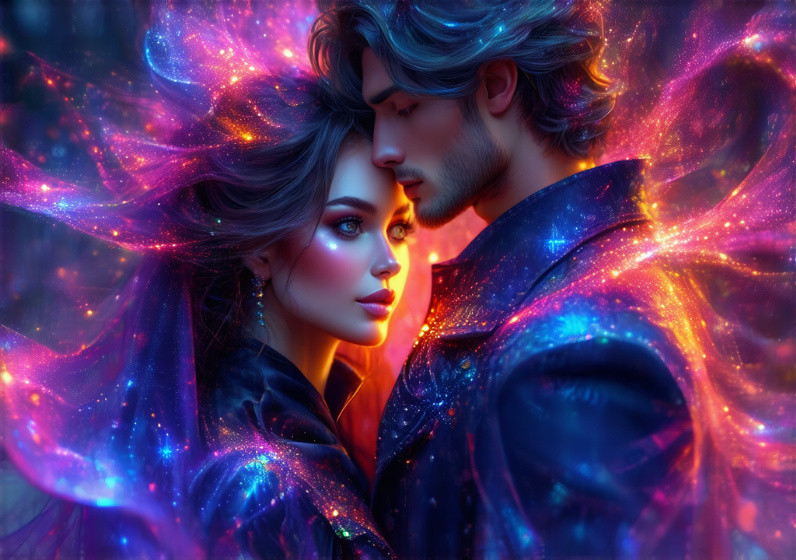
Two People, One Frequency: The Poetic Truth About Emotional Synchrony
Two People, One Frequency: The Poetic Truth About Emotional Synchrony
There is a particular kind of silence that exists only between two people who have found their way into the same emotional orbit. It is not an empty quiet; rather, it is a resonance, a hum in the chamber of shared understanding that requires no explanation and demands no performance. In philosophy, we often speak of synchrony as a mechanism of physics or a byproduct of habit. But when it occurs between two souls, it becomes something more akin to poetry: an accidental verse written in the language of the heart, where timing, tone, and intention collapse into a single, elegant movement.
To understand this phenomenon is to step away from the rigid structures of logic that govern our daily lives. We live in a world obsessed with metrics—heart rate monitors, productivity scores, and quantifiable outcomes. Yet, emotional synchrony resists measurement. It cannot be captured by an algorithm or tracked on a spreadsheet. It exists in the micro-expressions that precede a spoken word, in the way one person takes a breath exactly as the other begins to exhale, creating a seamless exchange of air, emotion, and intent. This is the poetic truth at the heart of human connection: we are not merely two separate entities interacting; under certain rare conditions, we become a single frequency, broadcasting and receiving on the same wavelength.
Consider the phenomenology of this state. When you look at someone you have achieved deep synchrony with, there is a dissolving of the boundary between self and other. In ordinary interaction, there is always a slight delay, a tiny lag between stimulus and response, much like an echo in a large hall. But in true emotional synchrony, that echo vanishes. The anticipation becomes part of the event itself. You know what they are going to say before the syllables form; they understand your hesitation before you articulate it. Philosophers have long debated the nature of the self and its permeability. In these moments of deep connection, the membrane of the ego grows thin, becoming almost transparent. The "I" bleeds into the "you," and in that space between, a third entity is born—a shared consciousness that belongs to neither individually but to both collectively.
This state carries an ancient weight. Long before we had words for psychology or neuroscience, poets and mystics understood this frequency. They spoke of "souls recognizing souls" or "hearts beating as one." These were not merely flowery metaphors; they were attempts to describe a tangible psychological reality. When two people are on the same frequency, time itself seems to alter. The urgency of clocks loses its grip. A single glance can contain the weight of hours, and an hour spent in this state can feel longer than a week of mundane labor. This is because the mind is no longer engaged in the exhausting work of decoding the other person's intent. The cognitive load vanishes, leaving only the pure, unmediated experience of being understood.
Let us examine what this means for our understanding of love and friendship. We are often taught that connection requires effort—that it must be built brick by brick through communication and compromise. And while this is true as a foundation, emotional synchrony transcends these mechanics. It is not something you can manufacture; it is something you can only discover or cultivate over time. Think of the old song lyrics we all know: "we were born to run together." That image captures the essence of this frequency. It implies a natural alignment, a gravity that pulls two separate orbits into a shared path.
There is also a philosophical paradox in this experience. For synchrony to be felt as "one," both individuals must remain distinct. If you completely merge with another person, you lose yourself; if you maintain too much distance, you lose them. The poetic truth here lies in the balance—the dance between autonomy and union. It is akin to a duet where two distinct voices blend so perfectly that the listener cannot tell where one ends and the other begins, yet both are still present. This requires a profound act of trust. To be on someone's frequency means you must allow them full access to your inner landscape without fear or pretense. You must be willing to be seen, heard, and understood in your most unguarded state.
In our fast-paced, digital age, this kind of deep synchrony is becoming rarer. We are constantly interrupted by notifications, distractions, and the general noise of modern life. Our attention is fragmented, and with it, our ability to achieve that resonant frequency. To find someone who matches your emotional rhythm in a world of constant motion is a rare privilege. It reminds us that we are not just consumers or producers; we are beings capable of profound, shared experience.
How do we recognize this when it happens? It often feels less like an event and more like a homecoming. There is a settling sensation, as if a piece of music has finally found its missing note. The world outside may remain chaotic, but within the bubble of that connection, there is a quiet clarity. Thoughts flow without friction; emotions are shared before they fully form in either mind. It is an experience of pure alignment.
As philosophers, we might also consider the ethics of this state. When two people share such deep synchrony, they enter a kind of invisible contract. They become responsible for each other's emotional weather. If one feels joy, the other shares it; if one grieves, the other stands in that storm with them. It is a mutual stewardship of experience. This does not mean you must always agree or feel the same things at all times, but there is an underlying current of empathy and understanding that carries you through the differences.
In the end, this poetic truth about emotional synchrony reminds us that we are more than our individual thoughts and actions. We are capable of creating a shared reality with another person—a frequency that is greater than the sum of its parts. It is a reminder that connection is not just about communication; it is about resonance. And when you find someone on your frequency, the result is something beautifully, quietly, and poetically real.