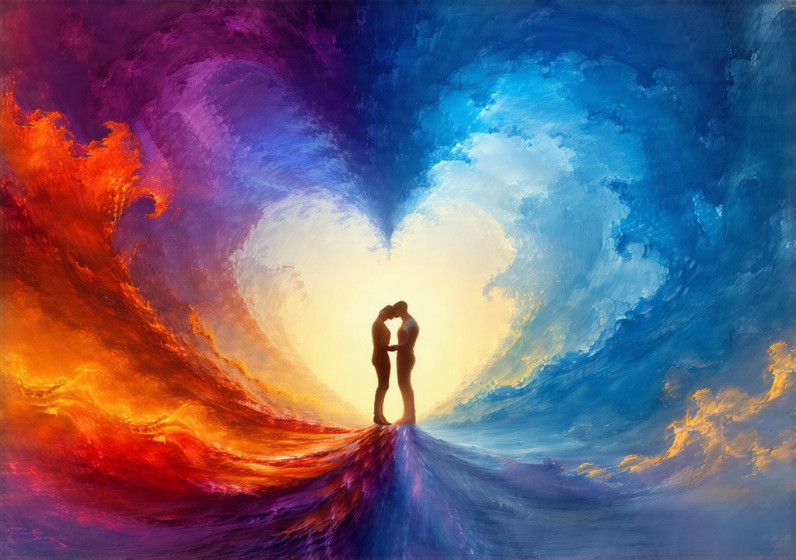
The Alchemy of Time: How Years Turn Pain into Tenderness
The Alchemy of Time: How Years Turn Pain into Tenderness
By Aurelia Vance, M.A. in Philosophy
There is a peculiar cruelty in memory. We often assume that time heals, but time does not heal; it merely buries. It packs the wounds tightly with years, with seasons, with the quiet accumulation of days until we forget the shape of the bruise. Yet, if we look closely—if we peer through the dusty glass of the mind—we will find that time is not a physician, but an alchemist. It does not erase pain; it transmute it. And what it produces from the base metal of our suffering is not happiness, nor is it forgetting. It is something far more fragile and far more precious: tenderness.
To understand this process, we must first deconstruct the nature of love. In common parlance, we speak of falling in love as if it were a gravity well—a sudden plunge into an orbit that defies logic. But philosophically, love is not a fall; it is a construction. It is a house built from the raw materials of two distinct selves: their fears, their histories, their small cruelties and their quiet kindnesses. In the beginning, we are so dazzled by the architecture of the other person that we ignore the foundation. We see the chandeliers and the frescoed ceilings; we do not notice the damp in the walls or the creaking floorboards. We love the idea of the person, and only later, when the romance has cooled into routine, are we forced to live in the reality of it.
This is where pain enters—not as a villain, but as a teacher. Pain, in the context of long-term affection, is rarely dramatic. It is not usually the shattering of a marriage or the sudden departure of a beloved. More often, it is the quiet accumulation of small misunderstandings. It is the moment your partner says something careless that cuts deeper than you expected, because you recognize your own insecurity in their words. It is the Sunday afternoon where the silence between you feels less like peace and more like distance. It is the realization that you have changed, and they have changed, and sometimes those two versions of yourselves no quite fit together anymore.
We tend to view these moments as failures. We want love to be a straight line, ascending forever into some idealized plateau of perpetual bliss. But love is not linear; it is cyclical. It breathes. And like all living things, it requires the friction of time to grow strong. Without resistance, muscle atrophies. Without pain, empathy remains theoretical rather than practical.
Consider the alchemical process itself. In medieval alchemy, the goal was not merely to turn lead into gold; it was to achieve a state of wholeness, a philosophical stone that could harmonize opposites. The process required three stages: calcination, dissolution, and conjunction. Calcination is the burning away of impurities. In love, this is the period where our pretenses burn off. We can no longer perform for each other because we have been seen in all our mundane, messy glory. The fire of daily life roasts away the romance until only the essential self remains. It is uncomfortable. It smells like smoke and ash. But it is necessary. If we did not burn off the illusion that the other person has a magic power to make us happy, we would never learn to be happy alongside them.
Dissolution follows. This is the stage where solid forms break down into liquid. In our relationships, this happens when the rigid structures we built around ourselves—our defenses, our expectations, our need for control—begin to melt. We become vulnerable again. We are no longer the armored knight; we are soft, permeable, and open to being shaped by the other person. This is where true intimacy lives. Not in the grand gestures, but in the dissolution of the barrier between "I" and "you." When I see you hurt, my pain becomes yours. When you laugh, my joy expands. We become a single alchemical vessel, heated by the sun of shared experience, until we are no longer two separate substances, but a new compound entirely.
And then comes conjunction. The union of opposites. In love, this is the moment where we accept that pain and tenderness are not enemies; they are siblings. We stop fighting the memory of the time you missed my birthday. We stop resenting the argument over the finances three years ago. Instead, we look at those moments with a new eye. We see them as evidence of our commitment to each other. We saw this pain because we cared enough to be hurt by it. The scar is not a mark of damage; it is a map of where we have been together. And in that recognition, the sharp edge of the pain softens into something warm and familiar. It becomes tender.
Tenderness is the final product of this alchemy. It is not the same as sweetness. Sweetness can be shallow, like sugar on top of bitter coffee. Tenderness has depth. It carries the weight of history. When you look at an old friend or a long-time partner with tenderness, you are looking at them through a lens that includes all the years of shared silence, shared laughter, and shared struggle. You know their shadows as well as their light. And because you have witnessed both, your affection is not based on illusion, but on knowledge.
This is why we often find ourselves loving people more deeply after difficult periods than before them. A couple who has survived a financial crisis, or a health scare, or the loss of a child, often reports a level of connection that was absent in the easier years. The pain did not break them; it fused them. It burned away the superficial layers and revealed the core relationship beneath. And what they found there was not perfect, but it was authentic. And authenticity is the foundation of true tenderness.
There is a philosophical implication here that we rarely consider. We live in a culture that celebrates resilience. We praise those who "bounce back" from tragedy. But perhaps what we should praise is not just the bouncing back, but the staying with. The willingness to sit in the pain without rushing to fix it. To hold space for the grief or the anger or the disappointment because you know that on the other side of it lies a deeper understanding. This is an act of philosophical devotion. It says: I will not abandon this experience, even though it hurts. I will let it change me.
And so, as we move through our own relationships—whether with partners, friends, or family—we are engaged in this quiet alchemy. Every shared meal, every difficult conversation, every silent drive home from work is a drop of reagent added to the mixture. We are heating and cooling, dissolving and reforming. And slowly, almost imperceptibly, we are turning the base metal of our daily interactions into something luminous.
We do not become gold, exactly. Gold is cold and rigid. What we produce is warmer than that. It is more like amber—fossilized light trapped in resin, glowing with a deep, internal warmth. And if you look closely at that amber, you might see the tiny insects or leaves preserved inside it—the small moments of our lives, frozen in time, but still alive with meaning.
So do not fear the pain in your relationships. Do not rush to dissolve it or disguise it. Let it calcine your pretenses. Let it dissolve your walls. And trust that on the other side of that fire lies a tenderness that no amount of easy happiness could ever produce. It is tender because it has been tested. It is beautiful because it was earned. And it lasts, not because time heals us, but because time teaches us how to be gentle with each other in the face of our own fragility.
We are all alchemists, whether we know it or not. We sit at the hearth of our lives, stirring the pot of years, watching for the moment when the smoke clears and the light changes. And when that moment comes—when you look at your partner, or your friend, or your child, and feel a surge of affection so deep it feels like grief in reverse—you will know that the alchemy has worked. The pain is gone. Or rather, it has become something else. Something soft. Something warm. Something tender.
And in that tenderness, we find not perfection, but presence. Not happiness, but meaning. And perhaps, for those of us who have studied philosophy long enough to know the difference, that is the closest thing to magic that love can offer.