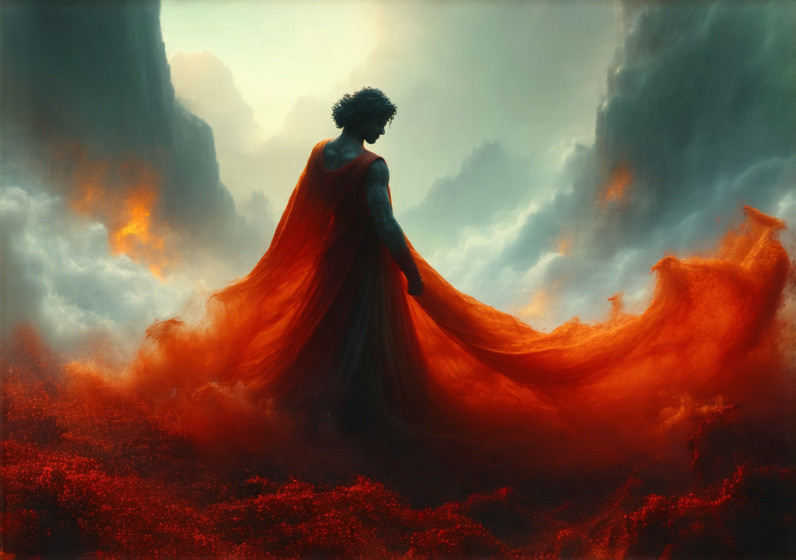
The Role of Dopamine in the Drama of First Encounters
✦ The Alchemy of First Encounters: How Dopamine Orchestrates the Theatre of Love ✦
By Dr. Celestine Voss, M.A.
There is a moment—fleeting, almost imperceptible—when two strangers cross paths and something shifts in the architecture of the self. A glance lingers a half-second too long. A voice carries an unexpected warmth. The air between them thickens with a charge that defies explanation. We call this "falling in love," but what we are witnessing is far more ancient, more mechanical, and more magnificent than romance suggests. It is neurochemistry performing its most elaborate theatre, and at the centre of the production stands a single, unassuming molecule: dopamine.
To understand why first encounters carry such disproportionate weight on our emotional lives, we must step back from the poetry and look at the machinery. Dopamine—often reduced in popular culture to a "pleasure chemical"—is, more precisely, a neurotransmitter that signals anticipation, prediction error, and desire. It does not register happiness so much as it registers possibility. And nothing in human experience generates possibility more powerfully than the first genuine encounter with another mind.
When you meet someone for the first time and feel that strange electric pull, what is actually happening in your brain is a cascade of dopamine release in the mesolimbic pathway—a neural highway running from the ventral tegmental area to the nucleus accumbens. This is the same circuitry activated by chocolate, music, gambling, and yes, cocaine. The brain does not distinguish neatly between a lover's smile and a winning lottery ticket; both activate the reward system with comparable intensity. What makes love unique is not the dopamine itself but its duration and its object-directedness. We are not merely seeking pleasure; we are latching onto another person as a living, breathing source of anticipated reward.
This is where philosophy enters the picture, because dopamine does not just explain why we feel something—it explains why we feel it so compulsively. The philosopher David Hume argued that reason alone cannot drive action; we need motivation, and motivation requires desire. Dopamine is desire made molecular. It transforms an abstract other person into a concrete target of our will. Without it, the stranger across the room remains just another body in space—interesting perhaps, but inert. With it, they become the person. The one. Irreplaceable.
There is something almost mystical about this mechanism. Consider: you have met thousands, perhaps tens of thousands, of other human beings over a lifetime. Most pass through your perceptual field and leave no trace. Yet on a particular evening, in a particular light, with a particular arrangement of hair and gesture and timbre of voice, one person ignites a neurochemical storm that can consume your thoughts for weeks, months, years. The selectivity is striking. Why this person and not the next?
Partly it is the novelty effect. Dopamine systems are exquisitely sensitive to new stimuli. A familiar face produces a modest dopamine response; an unfamiliar one, paired with the right aesthetic resonance, produces a surge. This is evolution working as intended: our ancestors needed to be alert to new partners, new social allies, new sources of information and resource-sharing. The brain rewarded attentiveness to novelty because it increased survival odds. In the context of romance, that evolutionary logic reads as fate, as destiny, as the universe aligning its gears for your particular story.
But dopamine also introduces a subtlety that philosophers have long grappled with: the gap between anticipation and experience. The dopaminergic system is fundamentally about wanting rather than liking. You can want something intensely without finding it pleasurable in the moment of possession. This explains a phenomenon every person who has been in love knows well: the initial intensity gradually softens, and what remains may be more tender but less electric. The dopamine fades as novelty diminishes. The brain, having catalogued the object, reduces its alertness. What was once an overwhelming mystery becomes familiar terrain.
This is not a failure of love; it is simply the neurochemistry reaching equilibrium. And here is where a philosophical reframe helps: if we treat the fading of dopamine-driven intensity as evidence that the romance has failed or diminished, we misread the signal. The drama of first encounters was never meant to be permanent. It was an initiation rite—a chemical baptism that moved you from indifference to attachment. What comes after is a different substance entirely: oxytocin and vasopressin, slower-acting neuropeptides associated with bonding, trust, and long-term commitment. Dopamine opens the door; these quieter molecules tend the garden.
There is also an ethical dimension worth considering. Because dopamine-driven desire can feel so all-consuming, it can be mistaken for knowledge. We assume that because we want this person overwhelmingly, we must know something true about them. But wanting is not knowing. The philosopher Gilbert Ryle distinguished between "knowing how" and "knowing that," and a similar distinction applies here: the intensity of our desire tells us something about our own neurochemistry, not necessarily about the other person's character, compatibility, or virtue. Two people can be wildly compatible in dopamine response—magnetically, beautifully so—and still discover over time that their values, rhythms, and worldviews are largely misaligned. The initial chemistry is necessary but not sufficient for a lasting union.
This does not diminish the beauty of first encounters. If anything, understanding the mechanism deepens it. Knowing that your heart is pounding because of a 40-million-year-old reward circuitry does not make the moment less real; it makes it more remarkable. You are witnessing, in miniature, one of evolution's most elegant solutions to the problem of social bonding. A single molecule, produced by a cluster of neurons no larger than a grain of rice, is orchestrating a symphony that will shape your years to come. There is something almost alchemical about it—base chemistry transmuted into meaning, memory, identity.
And perhaps that is the deepest philosophical insight dopamine offers: we are not as autonomous as we like to imagine. We tell ourselves we choose our lovers rationally, deliberately, with full knowledge of their virtues and vices. But in those first crucial moments, it is a molecule speaking through us, and we are its willing instruments. The drama of first encounters is, at bottom, a story the body tells the mind—a story so compelling that the mind adopts it as truth.
So the next time you find yourself caught in that electric, breathless moment of a first encounter—when the room seems to narrow to a single point of light and your thoughts go quiet—do not rush to interpret it. Do not mistake the chemistry for the whole story. But also do not diminish it. Let the dopamine do its work. Let the novelty sing. And then, when the storm settles and the quiet oxytocin begins its slower work, you will have both: the drama of first encounters and the patience to see what endures beyond it.
After all, love is not a single chemical event. It is a long collaboration between molecules and meaning, between the ancient brain and the reflective mind. Dopamine lights the match; everything after that is up to you.