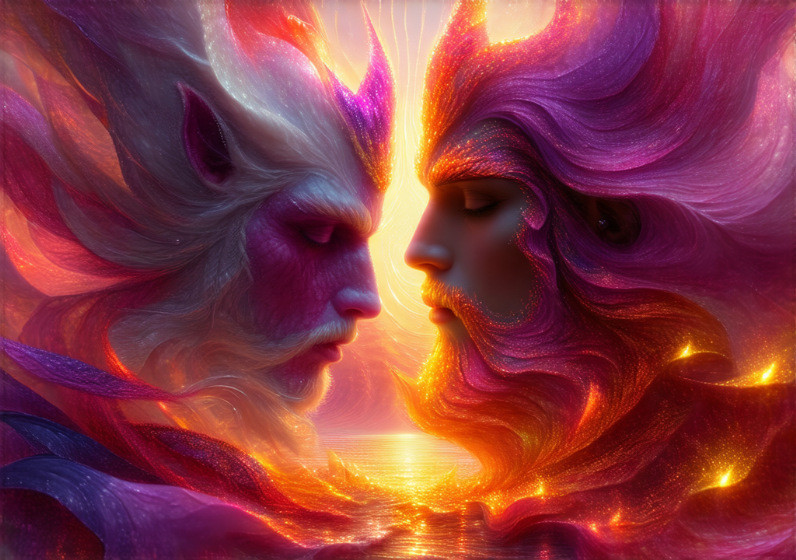
Rainbow Bridge: How to Build a Truly Mutual Bond
Building a Rainbow Bridge 🌈
Falling in love is often imagined as a single, luminous moment—a spark that ignites and never dims. Philosophically speaking, however, true romantic bonding is far more complex than an instantaneous chemical or emotional event. It is not merely the act of falling; it is the deliberate, ongoing architecture of a shared life. To build a truly mutual bond—one that resembles a rainbow bridge rather than a fragile glass tower—couples must navigate the delicate interplay of autonomy and unity, vulnerability and strength, and idealism and reality.
A rainbow bridge is not made of a single color; it is a spectrum woven from many distinct hues. Similarly, a healthy partnership requires a variety of virtues working in concert. When we examine what makes a bond truly mutual, we find that it rests on three philosophical pillars: authentic self-awareness, the dialectic of individuality and togetherness, and the shared creation of meaning.
The Architecture of Authenticity 🌹
Before two people can build a bridge between their worlds, each must understand the terrain they are bringing to the relationship. This is where philosophy asks us to confront the self. In an age that often celebrates blending into one another—becoming "we" so completely that "I" disappears—a truly mutual bond demands that both partners maintain a coherent sense of self.
Authenticity in love means showing up as your actual, imperfect, evolving person rather than a curated version designed to please or attract. The philosopher Simone de Beauvoir explored how individuals often seek security and identity through their relationships with others, sometimes at the cost of their own freedom. In modern terms, this can look like codependency: shaping your desires, hobbies, and opinions to mirror your partner's. While this creates a comfortable illusion of unity, it is not true mutuality—it is mirroring.
Building a rainbow bridge requires each person to know their own colors first. What are your core values? What do you genuinely want from life? When partners enter the relationship as whole individuals rather than empty vessels waiting to be filled, the bond becomes an exchange of richness instead of a transaction of need. Authenticity also means embracing vulnerability. To love someone mutually is to say: "Here is my unfiltered self; I trust you not to use it against me." This act of philosophical and emotional courage is the foundation upon which all other colors of the bridge are laid.
The Dialectic of Self and Other 🌿
Hegel spoke of the dialectic—a process where two opposing forces interact to produce a higher truth. In a romantic bond, this plays out in the constant negotiation between individuality and unity. A truly mutual relationship is not one where partners merge into a single entity; it is one where they honor both their separateness and their connectedness.
Think of a rainbow bridge as two sturdy anchor points on either side of a river, joined by an arch. If you remove one anchor point, the bridge collapses. In love, if one partner loses their autonomy to please the other, or if one becomes so independent they no longer need the relationship, the structure fails. Mutuality requires that both partners are strong enough to stand alone yet choose to walk together.
This dialectic shows up in everyday decisions. How do you spend your weekends? What do you want for your careers? Where do you draw the line between "my time" and "our time"? A mutual bond treats these questions not as threats to the relationship, but as opportunities to deepen understanding. It means celebrating each other's solo achievements without feeling threatened by them. It means giving space when one partner needs it and asking for that same grace when you need it. The bridge is strong precisely because of the tension between the two banks—it is not a rigid wall, but a flexible structure that can weather the winds of life.
Weaving Shared Meaning 🌟
Love is not just an emotion; it is a collaborative project. When two people build a truly mutual bond, they are not merely sharing a house or a bank account—they are co-authoring a story. This is what philosophers call "shared meaning." It is the invisible mortar that holds the stones of the bridge together.
Shared meaning can be found in grand gestures—buying a home, raising children, traveling to a distant country—but it is most often woven into the quiet, daily textures of life. It is the inside joke that only you two understand. It is the ritual of Sunday morning coffee where you talk about your week without phones or distractions. It is the way you solve problems together, treating obstacles not as "me versus you" but as "us versus the situation."
When partners share a purpose or a set of values, they become collaborators rather than competitors. You begin to see each other's strengths as assets in the shared project and your weaknesses as areas where the other can provide support. This creates a deep sense of security and mutual respect. The bond becomes less about what one person gives and receives from the other, and more about what the two create together. A rainbow bridge is not just a path for crossing; it is a beautiful structure in its own right. Your shared meaning is that beauty—it is visible to others and felt deeply by those within it.
Navigating the Spectrum of Conflict 🌦️
No bridge stands without weathering storms, and no relationship survives without conflict. In fact, how two people handle disagreement often reveals more about the quality of their bond than how they act during times of harmony. A truly mutual bond treats conflict not as a failure of love, but as an opportunity for philosophical inquiry.
When friction arises, the ego often wants to win. The goal becomes proving you are right and your partner is wrong. But in a mutual relationship, the goal shifts. You begin to ask: "What does this disagreement reveal about our needs? What can we learn from each other's perspectives?" This requires intellectual humility—the recognition that your view of reality, while valid for you, may be incomplete without your partner's input.
Navigating the spectrum means acknowledging that both partners will bring different emotional colors to a situation. One might need logic and space; the other might need empathy and touch. A mutual bond respects these differences. It creates a shared language for conflict—agreements on how to argue, when to take a break, and how to repair after a storm passes. The goal is not to eliminate all negative colors from your bridge; it is to ensure that every color, bright or muted, has its proper place in the structure.
The Ongoing Work of Love 🌻
Perhaps the most important philosophical insight about building a mutual bond is that it is never finished. A rainbow bridge does not build itself overnight, and it does not require no maintenance once complete. It must be tended, repaired, and occasionally reimagined as the seasons change.
As people grow—through career changes, health shifts, personal maturation—their colors shift too. What felt like a perfect fit at twenty-five may need adjustment at forty or sixty. A truly mutual bond is flexible enough to accommodate this growth without breaking. It requires continuous communication, ongoing effort, and the willingness to fall in love with your partner's new versions over and over again.
There is a profound peace in this understanding. You are not looking for a perfect person who will complete you or make your life effortless. Instead, you are choosing to build something remarkable together. A bridge made of many colors, anchored by two strong individuals, spanning the river between separate lives into a shared journey. It is a structure that requires constant care, but one that offers shelter from storms and a beautiful view for every day in between.
To build this kind of bond, you must be willing to do the work—deep, quiet, often unglamorous work. You must practice authenticity even when it feels risky. You must honor individuality even when togetherness is more comfortable. You must create shared meaning through both grand gestures and small daily rituals. And you must treat conflict as a teacher rather than an enemy.
A rainbow bridge is one of the most beautiful structures in nature—temporary, vibrant, and requiring specific conditions to appear. A truly mutual bond carries that same quality: it is temporary because life itself is finite; it is vibrant because it is built on passion and creativity; and it requires specific conditions—trust, respect, effort, and love—to remain visible. Build those conditions with intention, tend your bridge with care, and you will have constructed something far more enduring than a simple spark. You will have built a home in the sky for two souls to walk together. 🌈