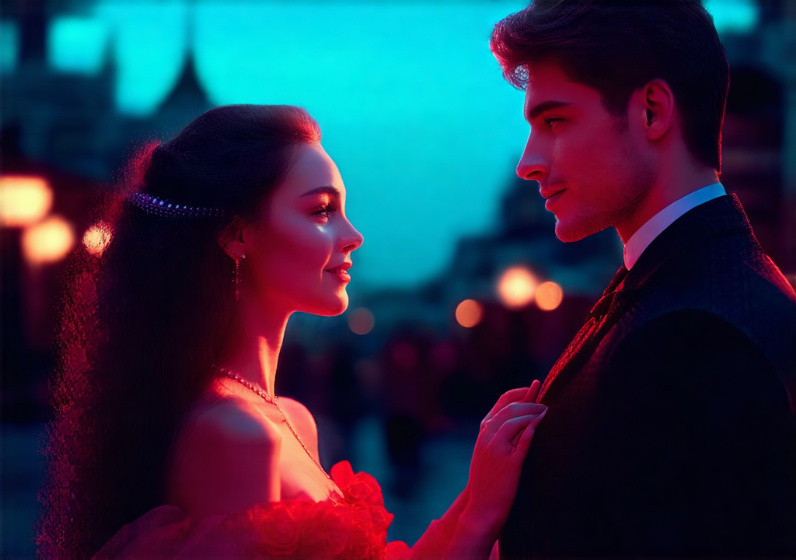
Why Your Favorite Movie Romance Is Actually a Textbook Example of Anxious Attachment
Why Your Favorite Movie Romance Is Actually a Textbook Example of Anxious Attachment 💞
Have you ever watched a romantic film and felt an intense, almost physical ache in your chest when the couple was apart? Maybe you found yourself checking their eyes for subtle shifts in mood, or feeling a surge of anxiety when one character mentioned another person. You told yourself it was just good storytelling, but as someone who has spent years studying the architecture of human connection through the lens of philosophy and psychology, I want to suggest something else: your favorite movie romance is likely a perfect, polished mirror reflecting your own anxious attachment style. 🎬
We are taught to believe that great love stories are about destiny, grand gestures, and soulmates. Cinema has spent over a century refining this narrative arc—the chance meeting, the spark, the misunderstanding, the dramatic separation, and the triumphant reunion. We consume these stories not just for entertainment, but because they validate our own emotional experiences. However, if we look closely at the mechanics of these plots through the framework of attachment theory, we begin to see that many beloved rom-coms are actually masterclasses in anxious-avoidant dynamics. And more importantly, they show us how anxiety is often mistaken for passion.
Let's take a classic trope: the "misunderstanding." In countless films, one partner leaves or pulls away not because their feelings have faded, but to prove a point, or because they are afraid of being seen in their vulnerability. The other partner—often our protagonist—immediately assumes it means they are unloved. They call repeatedly. They wait outside windows. They craft elaborate plans to win the person back. In attachment terms, this is the anxious partner's "protest behavior" in action. It is a subconscious strategy to reduce uncertainty and restore proximity. The anxious individual craves emotional availability; when it becomes ambiguous, their nervous system interprets that ambiguity as danger. The movie romance amplifies this by turning internal psychological states into external, dramatic actions. We watch the protagonist storm across town or write a heartfelt letter in the rain, and we feel inspired. But philosophically speaking, are we celebrating the beauty of love, or are we romanticizing the struggle for reassurance?
This is where the philosophical dimension becomes crucial. Immanuel Kant argued that to truly treat someone as an end in themselves, rather than a means to an end, requires a deep respect for their autonomy and separate existence. In anxious attachment, this boundary often blurs. The lover seeks to merge with the other person to extinguish the fear of abandonment. The movie reinforces this by portraying the "other" as the sole source of happiness or misery. When they leave, the world goes gray. When they return, the sun comes back out. This is a philosophical error known as conflation—the merging of self and other. True love, in its most mature form, allows for two distinct beings to coexist without needing to collapse into one entity. Yet, anxious attachment craves that collapse because it feels like safety.
Consider the role of the "grand gesture." The rooftop speech, the airport chase, the song performed in a public square. These are iconic moments that we rewatch because they satisfy our need for narrative closure and emotional validation. For someone with an avoidant attachment style, these gestures can feel suffocating or performative; it's too much intensity without enough space. But for the anxious attached viewer, these scenes are cathartic. They confirm a deep-seated belief: that if we just prove our love loudly enough, we will be chosen. That if we make ourselves visible and vulnerable in grand ways, rejection becomes impossible. We learn to equate volume with validity. If my feelings aren't shouted from the rooftops, they don't count. If my partner doesn't chase me across tarmac, I must not matter.
There is a subtle irony here that often goes unnoticed by casual viewers but shines brightly under philosophical scrutiny. The movie romance usually ends with a happy ending—reconciliation and commitment. This creates a cultural script where anxiety is rewarded. Because the anxious behaviors (the chasing, the questioning, the dramatic displays) successfully bring about the desired union in the film, we subconsciously learn that this is how love works. We don't see the therapy sessions or the quiet conversations about boundaries because they aren't cinematic. We don't see the years of managing the anxiety once the drama settles because stillness doesn't make for a three-act structure. As a result, many people enter real-life relationships expecting that their partner will constantly provide the emotional regulation that the anxious attachment system desperately seeks externally. When the real relationship becomes stable and quiet, the anxious individual may feel a strange loss of passion, mistaking the calm for a lack of love. They begin to create drama or seek external validation because they have confused the turbulence of anxious pursuit with the depth of genuine connection.
Let's also look at the character development in these films. Often, the avoidant partner learns to open up, and the anxious partner learns to trust. This is the idealized growth arc that philosophers like Aristotle would recognize as eudaimonia—flourishing through virtue and balance. However, for viewers who identify strongly with the anxious role, this can be a source of subtle shame. We see our most vulnerable, needy traits being portrayed as something to be "fixed" or managed by the other person's stability. The movie suggests that if you just become more independent and less clingy, your partner will love you more. But in reality, healthy relationships aren't about fixing one person; they are about two people with different attachment styles learning to meet each other in the middle.
So, how does this understanding change the way we watch? It transforms passive consumption into active self-reflection. Next time you see a character anxiously checking their phone or waiting by the door, instead of just cheering for them, try asking: "Where do I do this?" Or when you feel that familiar tightness in your chest during a separation scene, recognize it as your own attachment system being activated. You are watching your own psychology played out on screen. It's not just a story about fictional characters; it is a script written by human nature, refined by Hollywood until it feels universal.
Understanding this connection doesn't mean you should stop enjoying romantic movies. On the contrary, it can make them more profound. When you recognize that the drama stems from attachment needs—needs for security, reassurance, and emotional safety—you start to see the beauty in those needs rather than just the chaos they create. You begin to appreciate that anxiety is not a flaw; it is a signal. It tells us what we value and where our wounds lie. The anxious attached individual loves deeply, observes keenly, and feels intensely. These are philosophical gifts if harnessed with self-awareness.
Perhaps the most important lesson these movies teach us, once seen through this lens, is about the difference between performance and presence. Movie romance is performed; it's designed to be watched. Real love is present; it's designed to be lived. The anxiety you feel while watching a film is actually a map of your own emotional landscape. It points to where you seek validation, how you handle uncertainty, and what you believe love should look like. By acknowledging that your favorite rom-coms are essentially textbooks on anxious attachment, you take back the narrative power. You stop being a passive audience member and become an author of your own relational story.
You can choose to love with awareness rather than just intensity. You can ask for reassurance without demanding it. You can value the quiet moments as much as the grand gestures. And you can see that true romantic fulfillment comes not from convincing someone they should stay, but from creating a space where both people feel safe enough to be truly known—including their anxious, hopeful, fearful, and beautifully human selves.
So the next time you queue up your favorite romance film, lean in with new eyes. Watch for the subtle cues of attachment styles. Notice how the characters seek proximity or distance. See the anxiety as a language, not just a plot device. You might find that the movie isn't teaching you how to find love; it's helping you understand how you already have it. And that understanding? That is where real romance begins. ✨
Dr. Elena Vance
Philosopher & Relational Dynamic Analyst