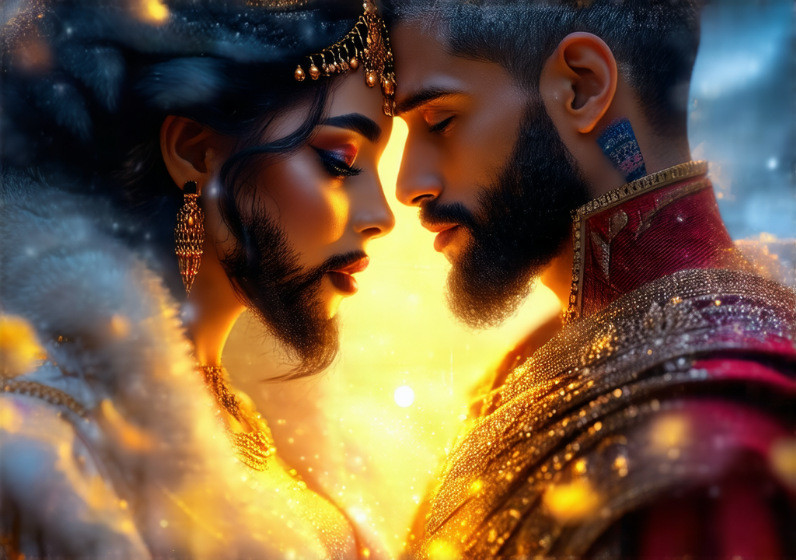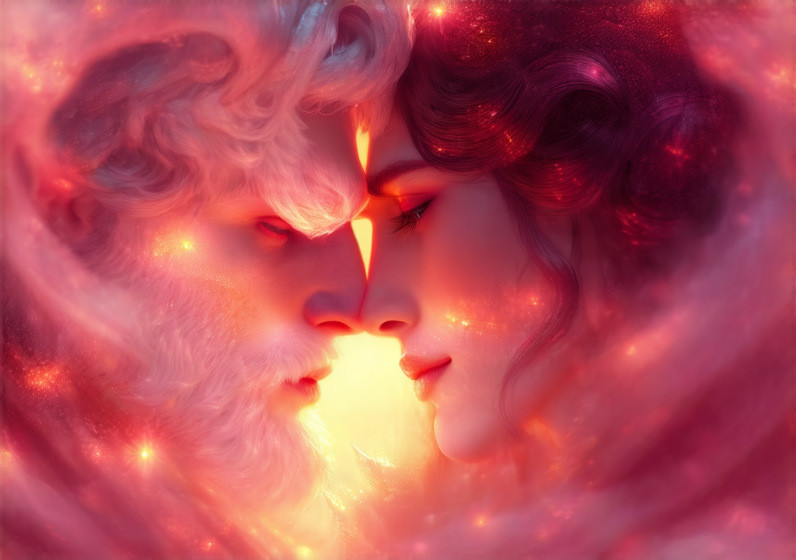
Falling in Love Is Chemistry. Symbiotic Love Is Ecology.
Falling in Love Is Chemistry. Symbiotic Love Is Ecology. 💞
The Spark That Ignites Everything ✨
Falling in love is often described as a chemical event — and that metaphor holds up remarkably well. Neurotransmitters flood the brain: dopamine, oxytocin, serotonin, norepinephrine. A cascade of molecular signals that produce euphoria, obsessive focus, and an almost physical hunger for another person's presence. The body behaves like a laboratory in full reaction, and we behave accordingly: sleep shrinks, appetite wavers, attention narrows to a single face in a crowd.
Chemistry is brilliant precisely because it is transient. The very neurochemistry that makes love feel like revelation is calibrated to fade. Dopamine-driven excitement has a half-life; oxytocin's bonding effects plateau. This isn't a flaw — it's a feature of how brains work. The initial blaze is designed to draw two organisms together, to overcome the social and logistical friction that keeping strangers apart would require. Chemistry is the match struck in the dark.
What many people mistake for "true love" is actually this chemical phase, or at least the cultural narrative wrapped around it. We build myths about soulmates, about the person who will make the fireworks never stop. And when the neurochemistry normalizes — as it inevitably does, typically over eighteen months to three years — we experience a quiet disillusionment. The magic seems to have evaporated. We question whether this was really love or just a very convincing neurological trick.
The shift from chemistry to something more durable is not a failure of romance. It is the next chapter. And that next chapter is best understood not as another reaction between molecules, but as an ecosystem — a living, interdependent web of mutual sustenance. This is symbiotic love, and it belongs to ecology rather than chemistry. 🌿
Symbiosis: The Deeper Architecture 💡
In biology, symbiosis describes any close, long-term interaction between different species that benefits at least one partner, often both. Mutualism — where both organisms gain — is the form most relevant to mature love. Mycorrhizal networks in forests are a vivid parallel: fungal threads connect tree roots, trading nutrients and chemical signals across an underground web. No single tree feeds the forest; the relationship between root and mycelium does. Remove one, and both suffer.
Symbiotic love operates on this logic. Two people become nodes in a shared system where each contributes something the other needs — emotional regulation, intellectual stimulation, practical support, creative resonance, quiet companionship. Neither is the whole; together they form a structure that produces more than either could alone. This is not dependency. Dependency implies one organism consuming or parasitizing the other. Symbiosis implies reciprocal growth, where each partner's flourishing enhances the other's capacity to flourish in turn.
This ecological framing changes how we think about conflict, too. In a chemical model, friction feels like the love dying — the reaction is no longer exothermic, so something must be wrong. In an ecosystem, tension is nutrient cycling. Nitrogen must break down and recombine; forests need fire to regenerate. Arguments in a symbiotic relationship are not evidence of incompatibility; they are the metabolic process by which two people renegotiate boundaries, clarify needs, and redistribute emotional energy. The system adapts because it is alive, not because it is chemically stable.
From Reaction to Relationship 🌱
The transition from chemical to ecological love requires a change in what we optimize for. Chemistry optimizes for intensity — the peak of the curve, the rush, the electric charge. Ecology optimizes for sustainability — the long arc of mutual benefit, the steady state where both organisms thrive without depleting the shared resource base.
Practically, this means shifting attention from "do I feel a spark?" to "are we growing together in ways that serve both of us?" It means asking not just "how do you make me feel right now?" but also "what are you needing that I'm not providing? What am I taking for granted in the exchange?" Ecology is inherently relational and systemic. You cannot understand a forest by studying one leaf in isolation; you must study the light, the soil, the water cycle, the fungal network, the birds that disperse seeds. Similarly, understanding your love requires looking at the whole system: communication patterns, shared values, division of labor, emotional safety, growth trajectories.
It also means accepting a certain humility. In chemistry, reactions are predictable — given the right reagents and conditions, you get the product every time. Ecosystems are not so tidy. They are emergent, context-dependent, sensitive to small perturbations. A symbiotic relationship cannot be engineered to order; it must be tended, observed, and allowed to evolve. Seasons change in a forest; relationships have seasons too. There will be dry spells and abundant years. The goal is not perpetual peak performance but resilient adaptation.
The Myth of the Perfect Match 🌺
Chemistry culture sells us the idea that the right person will make love feel effortless forever. Ecology tells a more honest story: no two organisms are perfectly matched, but compatibility emerges from fit, and fit can be cultivated. In nature, species co-evolve — host plant and pollinator shape each other over generations. In relationships, partners shape each other continuously. You become slightly more patient because they need it; they become more expressive because you model it. The relationship is not a found object but a made one, built in small daily acts of reciprocal adaptation.
This does not mean love requires constant labor or that it must be "worked on" in a grinding sense. Symbiosis can feel effortless when the exchange is well-balanced and both partners are genuinely invested. The mycorrhizal network doesn't "work hard"; it simply is, because each organism's growth naturally serves the other. In a healthy symbiotic love, giving and receiving become almost indistinguishable — you support them not out of obligation but because their flourishing feeds your own. It feels like breathing: necessary, continuous, and easy when the system is in balance.
What This Means for How We Love 💫
Understanding love through both lenses gives us a more complete map. Chemistry explains why we fall — that initial magnetic pull, the intoxication, the sense of destiny. Ecology explains why we stay, grow, and deepen — the slow accumulation of mutual meaning, shared memory, reciprocal care. The first is the invitation; the second is the dwelling.
A person who only knows chemistry will chase new sparks forever, mistaking novelty for depth, and may leave relationships at the first sign that the initial fire has dimmed. A person who only knows ecology may miss the importance of passion, spontaneity, and desire — the very forces that make a relationship feel alive rather than merely functional. The full picture requires both: the spark to ignite, the soil to sustain.
And perhaps most importantly, this framing liberates us from a common anxiety: "Am I still in love?" In chemistry terms, yes, the intensity fades and you might worry something is broken. In ecology terms, the relationship may be thriving precisely because it has moved beyond the need for constant stimulation. The flowers bloom seasonally; the forest stands through winter. Symbiotic love endures not because it never changes, but because it changes together, adapting to new seasons without losing its underlying structure of mutual care and shared growth.
Falling in love is a beautiful chemical accident — two people collide at the right conditions and light up. Staying in love, deepening into it, building something that outlasts the initial reaction, is an ecological achievement: two organisms choosing, again and again, to grow toward each other within a shared environment of trust, respect, and reciprocal need. The chemistry gets you in the door. The ecology keeps the home alive. 🌍
— Dr. Elena Voss