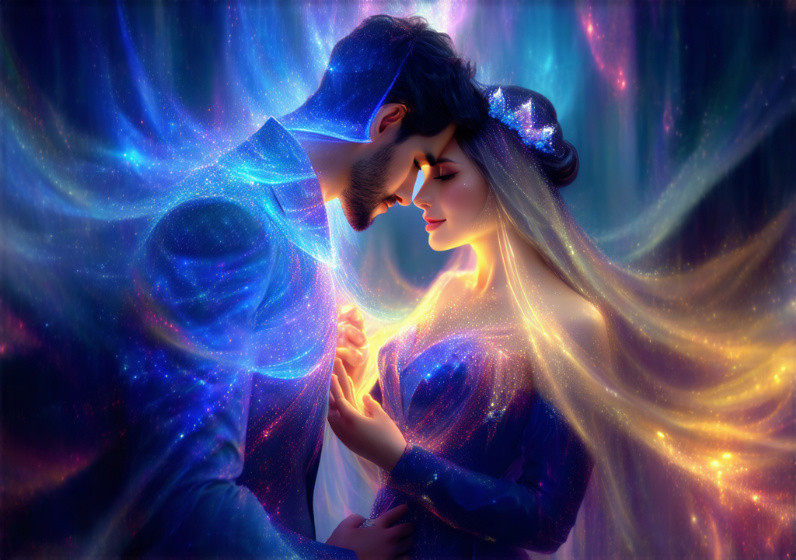
Is It Love or Familiarity? Debunking the Science of First Sight
✨ The Illusion of First Sight 🕯️
By Elara Voss
There is a peculiar alchemy to falling in love. We speak of it as though it were a celestial event—sudden, luminous, inevitable—as if the universe conspired to align two souls at precisely the right coordinate in space and time. Yet beneath this romantic mythology lies something far more mundane, far more mechanical: the brain, doing its quiet, chemical work in the dark.
The question that haunts so many of us is not whether love exists—it manifestly does—but how it begins. Is it truly first sight? That lightning strike of recognition across a crowded room? Or is it something slower, something woven from repetition and familiarity until what was once a stranger becomes, by degrees, an intimate? The science suggests the latter, though it would be reductive to say so without nuance.
The Chemistry Before the Poetry
Neuroscience has done remarkable work in recent decades mapping the architecture of romantic attachment. When we fall in love—truly fall—the brain activates a surprisingly specific constellation of regions: the ventral tegmental area, the caudate nucleus, the orbitofrontal cortex. Dopamine floods the system. Oxytocin binds. Cortisol drops. The result is a state that neuroscientists have been known to compare to addiction, and not without reason. The person we love becomes, in a very literal neurological sense, a reward signal.
But here is where the popular narrative stumbles. We tend to imagine that this chemical cascade is caused by some essential quality of the beloved—that we see their soul and our brain responds with fireworks. In reality, the cascade is largely anticipatory. It fires in response to novelty, to possibility, to the gap between what we know and what we hope to learn. The brain does not fall in love with a person so much as it falls in love with the possibility of that person, the unfinished story, the blank page.
This has a quiet implication: first sight is not a revelation. It is an invitation. And invitations can be extended to almost anyone.
Familiarity Is Not a Flaw—It Is a Foundation
There is a persistent cultural bias against familiarity in love. We prize spontaneity, surprise, the electric jolt of the new. And justifiably so; novelty activates the dopaminergic pathways that give early romance its shimmering intensity. But there is an equally powerful force working in parallel, one that rarely gets the poetic treatment: mere exposure.
The psychology literature on this is robust and unambiguous. The more we encounter a stimulus—whether it's a melody, a face, or a voice—the more we tend to rate it as pleasant. This is not a bug in human cognition; it is a feature. Our brains are pattern-recognition engines, and repetition reduces the cognitive load required to process a person. What was once a stranger requiring full attention becomes someone whose rhythms, quirks, and silences require less interpretive labor. The mind, freed from the work of decoding, can begin to enjoy rather than merely process.
This is why long friendship so often precedes or undergirds enduring love. It is not a lesser form of romance; it is the soil in which deeper roots take hold. Familiarity does not kill the spark—it composts the initial heat into something more sustainable, less dependent on the nervous system's peak performance.
The Myth of the Soul Mate as Scientific Fact
Perhaps the most persistent folk-psychological claim about love is that there exists a single correct person for each of us, and that finding them produces an unmistakable sensation—a knowing—that no other pairing could replicate. The philosopher Immanuel Kant spoke of a "common sense" underlying aesthetic judgment; in love, we seem to expect something analogous: a universal recognition code, a key-and-lock mechanism between two minds.
The evidence for this is thin. Studies on couples who have been together for decades show that their brain scans during the experience of looking at their partner activate regions associated with deep comfort and security rather than the intense reward circuits of new love. The fireworks dim; the hearth burns steadily. This transition is not a failure or a diminishment—it is maturation. It is the difference between a bonfire and a well-tended stove. Both produce warmth; only one keeps you alive through winter.
To say this with philosophical clarity: love is not a discovery of pre-existing truth about another person. No such Platonic essence is hidden beneath the skin, waiting to be unveiled by the right gaze. We construct our understanding of the beloved over time, through shared experience, miscommunication, repair, and the slow accumulation of small knowing. The person we fall in love with is not fully available at first sight. They are, in a very real sense, made within the relationship itself—co-authored by both parties across months and years.
The Role of Vulnerability and Narrative
Here is where philosophy must step back into the frame, because neuroscience alone cannot account for what we mean when we say "I love you." The neurochemical story explains a great deal about the mechanics of attraction, but it says little about the narrative structure of love—the stories we tell ourselves about why this person and not another, what our bond means in the larger arc of a life.
Humans are meaning-making creatures. We do not merely experience emotions; we interpret them. The person who feels a flutter in their chest upon seeing a stranger may interpret it as destiny or as simple curiosity. The person who has shared ten years of Tuesday dinners with another may feel a quieter, deeper tenderness that the first category never captured. Both are real. Neither is superior. But only one tends to be recognized culturally as "true love," which says more about our storytelling preferences than about any objective hierarchy of feeling.
There is something deeply human in this preference for the dramatic over the domestic, the lightning strike over the slow dawn. We want our love stories to have a clear inciting incident, a moment where everything changes. And sometimes there is such a moment. But more often, love arrives as an accumulation—so gradual that we cannot point to its beginning, so woven into the fabric of daily life that it becomes invisible until we lose it or imagine losing it.
Toward a More Honest Romance
What does all this mean for how we understand and seek love? A few suggestions, offered not as prescriptions but as invitations to reconsider inherited assumptions:
First, resist the pressure to experience love as an instantaneous event. If you meet someone and feel only mild interest, that is not a failure of destiny; it may simply be where the process begins. The brain needs time. The story needs chapters.
Second, give yourself permission for the quiet forms of devotion. Not every act of love must be grand or performative. Remembering how someone takes their coffee, staying up to listen when they are struggling, choosing patience over reaction in small daily frictions—these are not lesser expressions than a declaration in the rain. They may be more durable.
Third, recognize that you will change, and so will your partner. The person who moves you on a first date is not the same person you will know five years later. This is not a problem to be solved but a reality to be embraced. Love, if it lasts, must be continuously re-learned, re-narrated, re-chosen. It is an active verb, not a static state.
And finally—perhaps most importantly—release the need for certainty. We want love to arrive with a label, a confirmation, a cosmic seal of approval. The science says it arrives without one. You must feel your way forward, interpret the signals, decide whether this person's particular rhythm resonates with yours. There is no algorithm. No scanner. Only attention, time, and the willingness to keep looking.
A Closing Meditation
The poet Rainer Maria Rilke wrote: "Two solitudes, one encounter." There is a profound truth in those words that the neuroscience confirms but cannot quite articulate: we are each, fundamentally, alone with our own consciousness. And love—real love, enduring love—is not the erasure of that solitude but its acknowledgment, its gentle bridging. We do not merge into one being. We remain two minds, two histories, two sets of chemistries, choosing again and again to make meaning together in a universe indifferent to our arrangements.
First sight is where the story begins. But it is not where the story lives. The story lives in the long middle—in the ordinary, unglamorous, deeply human work of learning another person's language and being learned in return. That is not less than love. It is love. Stripped of its mythological trappings, tested by time, made real by repetition.
And perhaps that is the most beautiful thing about it: not that it arrives like lightning, but that it stays like a flame you tend, night after night, in the small and sacred space between two people who have chosen to keep looking at each other long after the first spark has settled into steady warmth.