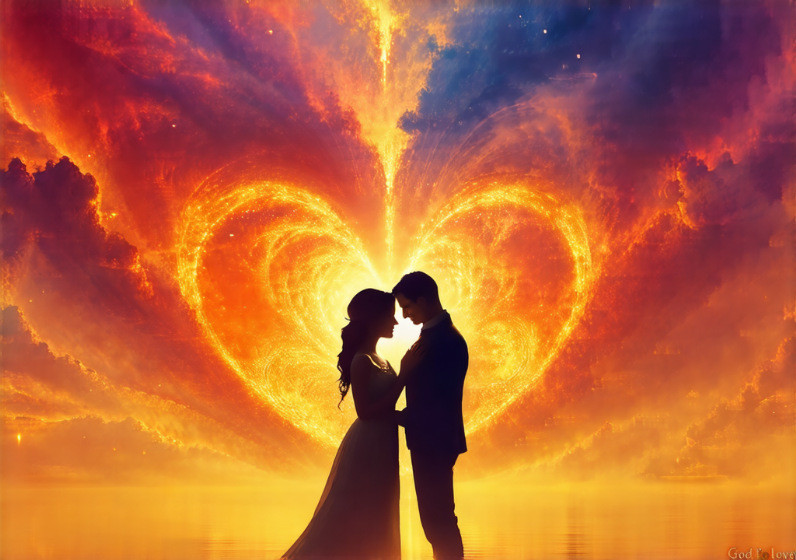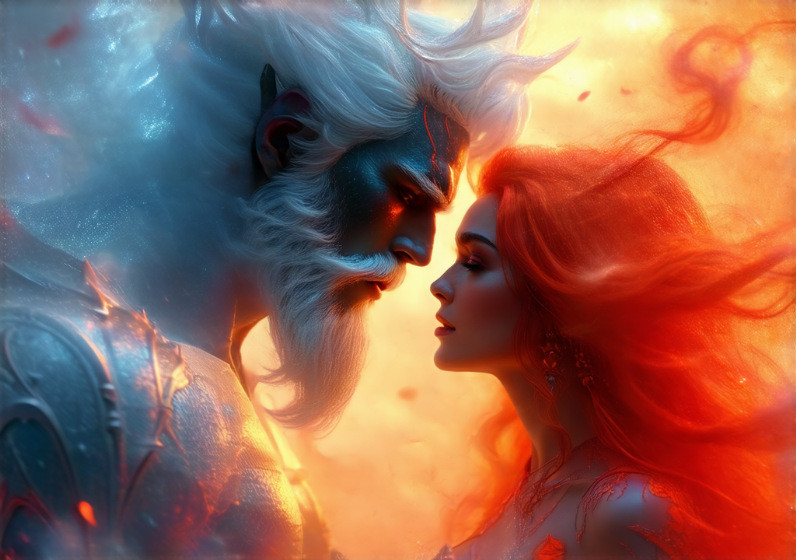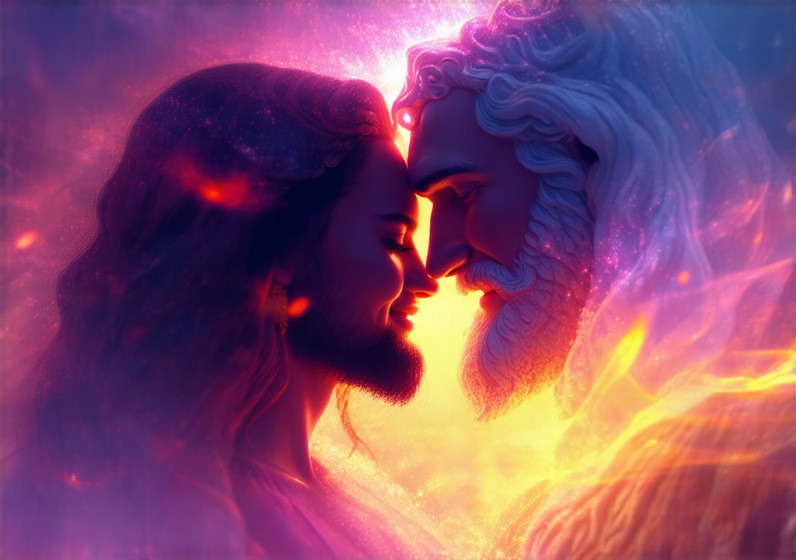
The Poetics of Renewal: Metaphors for Fire That Refuses to Die
✦ The Phosphorescence of Heartbreak: Why We Fall Again in the Ashes of Flame
A Meditation on Ruin, Resurrection, and the Alchemy of Longing
There is a particular quality to grief that philosophers have struggled to articulate without resorting to the language of death. We speak of lovers as if they are corpses—lost, dead, buried. The romantic vocabulary of our culture is mortuary in its precision. A relationship ends, and we say the love has died. But this is a linguistic error born of a conceptual one: we have mistaken the end of a narrative arc for the annihilation of the subject. Love does not die. It undergoes metamorphosis. It enters a state of suspended animation so profound that the body forgets it was ever alive, yet somewhere in the marrow, in the phosphorescent deep places of memory, the fire refuses to go out.
To write about falling in love—truly writing about it, not merely cataloguing its symptoms—is to engage with one of the oldest metaphysical problems in Western thought: the paradox of impermanence and desire. Why do we long for that which has proven itself fleeting? If the first love was a failure—if it ended, if it broke, if it left us stranded on the cold shores of solitude—why does the soul not learn from this evidence? Why do we return to the water knowing we will drown again? This is not a question of psychology or neurochemistry, though both have their say. It is a question of metaphysics. It is a question about what it means to be a creature that knows, with full intellectual clarity, that all fire burns out, and yet continues to reach for the flame.
The metaphor of fire is, in this context, almost too perfect, and therefore requires some unpacking. Fire is not a thing. This is the first philosophical insight we must recover. When you say "the fire in my heart," you are not pointing at an object. You are describing a process—a sustained chemical reaction, a continuous transformation of energy. Fire exists only as long as it consumes something else. It is pure relationship: fuel meeting oxygen meeting heat. Remove any of these three terms and the fire ceases to be fire; it becomes smoke, or ash, or merely warm air. Love operates on exactly this principle. Love is not a substance we possess. It is a process we participate in. And processes do not end so much as they transform into other processes.
This is where the metaphor of renewal enters the philosophical frame, and here we must be precise about what "renewal" actually means. In common usage, to renew something is to make it new again—to restore it to a prior state. A renewed car looks like the car it was before. A renewed relationship, in this language, would look like the relationship it was. But this is not quite right. Renewal in the deeper metaphysical sense—what the alchemists called recreatio—is not restoration. It is creation after dissolution. The phoenix does not return to being the bird it was. It becomes a new bird that carries within its wings the memory of having been ash. The lover who falls again after heartbreak is not falling into the same love. They are falling into a different kind of knowing, one that has been tempered by loss.
Consider what we actually retain when a relationship ends. We do not lose the experience itself; experience, once had, becomes part of the architecture of the self in a way that no external force can reverse. What we lose is the narrative frame—the story we were telling ourselves about who we are and how the world works. The end of love, philosophically speaking, is the end of a particular epistemology. We had built a small universe around another person, a cosmos in which their presence was a fundamental constant. When they leave or die or simply drift into a life that does not intersect with ours, we do not lose our capacity for joy or connection. We lose a particular way of knowing. And the human mind, that restless engine of meaning-making, cannot tolerate a void where a framework used to be. So it builds another.
This is the secret of falling in love again: it is not ignorance. It is not the same fool jumping off the same cliff expecting different results. It is something far more interesting and far more human than that. It is the mind's refusal to accept that dissolution is final. It is the soul's insistence that if we can build a world once, we can build one again, even with the same hands, even after those hands have been burned.
There is a philosophical tradition—the Stoics in particular—would argue that this insistence is irrational, that a wise person would not repeat an action that led to suffering. The Stoic sage, in this view, loves without attachment, desires without need, and therefore cannot be wounded by the end of a relationship because they never truly needed it to continue. There is a certain elegance to this position, but there is also something almost alien about it when held against the grain of ordinary human experience. We are not sages. We are creatures who build cathedrals out of sand and then weep when the tide comes in, not because we did not know what sand is, but because the cathedral was beautiful while it stood, and beauty has a claim on us that transcends rational cost-benefit analysis.
The poet Rainer Maria Rilke wrote: "Because the dead love us better than the living." There is something true in this line, though it cuts in both directions. The dead—those who have departed, those relationships that are now memory rather than presence—love us with a kind of unchanging fidelity that the living cannot match. A finished relationship does not change its mind about you. It holds your place in its story permanently. And perhaps this is part of why we can fall again: because the dead versions of our past loves hold space for us, and knowing that they are holding it gives us a kind of permission to reach forward into new fires without feeling like we are betraying what came before.
But let us not romanticize this too cleanly. Falling in love after heartbreak is not always a noble act of philosophical courage. Sometimes it is pure terror—terror of being alone with one's own unmediated consciousness, which is, as phenomenology reminds us, an experience most humans find almost unbearable. We fall in love again partly because another person is easier to be near than our own mind. The body craves the warmth of another body not primarily for joy but because solitude is a form of heat death—a state where entropy wins and all structure dissolves into undifferentiated noise. Love, in this reading, is an entropic countermeasure. It is order imposed on chaos through the simple act of being seen by another mind.
And here we arrive at what I consider the central philosophical insight about falling in love: it is fundamentally an epistemological act before it is an emotional one. To fall in love with someone is to accept that your own perception of reality is incomplete, and that this other person holds a piece of the truth you cannot see on your own. It is the admission of finite knowledge dressed up as romance. We are drawn to others not because we are lonely, though loneliness helps; we are drawn to them because they know things we do not. They see angles of the world invisible to our particular vantage point. Love is, at its philosophical root, a collaborative epistemology—two minds trying, imperfectly, to approximate a truth that neither could reach alone.
This has practical implications for how we grieve and how we hope. If love is a process rather than a thing, then the end of one instance does not diminish our capacity for future instances any more than the burning out of one candle diminishes the sun's ability to light another. The fire does not run out; it transfers. What was fuel becomes ash, but the heat remains in the system. Your capacity for love is not a finite resource that depletes with use. It is, in a sense, generative—the more you give, the more there is to give. This is paradoxical from a materialist perspective, which expects resources to diminish through consumption, but it is deeply consistent with what we observe in the lives of people who have loved many times and lost many times and still reach for new flames with trembling, hopeful hands.
The online article asks me, as its philosophy columnist, to write this piece because there is a specific need in our community—a community of people who are tired, who have lost things, who are standing in the ashes of previous lives looking at the cold morning sky wondering if the sun will rise again. And it will. Not because we have earned it. Not because the universe owes us another chapter after the first one ended badly. But because we are creatures for whom fire is not merely a chemical reaction but an existential category. We do not just need warmth; we need witness. We need to be seen in our burning by at least one other mind, and when that witness leaves, we build new hearths and wait for the next soul brave enough or foolish enough to sit beside us in the light.
This is what it means to fall in love again after falling: it is not a mistake repeated. It is a truth affirmed. The first time you loved, you learned what fire feels like. The second time, you learn that the feeling does not require the same fuel. The third time, you learn that you are the one who burns, and the burning is not punishment but nature—your particular way of being present in a world that is otherwise indifferent to your warmth.
And perhaps this is the deepest metaphor for what it means to be human: we are the universe's way of knowing itself through fire. Not the cold, efficient, information-processing kind of knowing that machines do. The hot, wasteful, glorious, ash-producing kind of knowing that leaves a mark on everything it touches and cannot pretend otherwise. We fall in love because we are made of the same substance as flame—transient, hungry for fuel, beautiful in our brief combustion, and stubbornly, irrationally, beautifully persistent in our refusal to go out.
The fire refuses to die. Not because it can defeat entropy, but because dying would mean admitting that the burning never mattered. And we—the small, warm, temporary creatures of this particular corner of the universe—cannot afford that admission. We need the burning to matter. We need the ash to be beautiful. We need to believe that in the end, the fire was not wasted, even if it left nothing behind but a faint, sweet smell on our hands and a lingering warmth in our bones long after the last spark has faded into the dark.
And so we fall again. Not because we have forgotten how to grieve. Because we remember exactly how to burn, and we would be poorer without the remembering.