The Ontology of Wonder: What It Means to Love a Face You Have Not Yet Learned to Read
᚛ The Cartography of the Unfamiliar Soul ᚜
By Professor Aldric Vane, M.Phil.
To fall in love is not merely to find; it is to lose. It is a philosophical act of surrender where two distinct ontologies collide and begin, tentatively, to negotiate a shared space. We are taught that love is a destination, a state of arrival where the other becomes known, familiar, and safe. But this is a shallow reading of the human condition. True love does not begin in understanding; it begins in the magnificent, terrifying gap between self and other. It begins in the moment we look upon a face and realize that beneath that skin beats a universe as complex, chaotic, and incomprehensible as our own.
When you fall in love, you are not solving an equation. You are entering a dialogue with a stranger who speaks a language you have never learned to read. And so, the first chapter of any great romance is not one of intimacy, but of wonder. It is the ontology of surprise.
Consider the nature of the face we fall in love with. It is not a static object; it is a moving narrative. Every micro-expression, every shift in tone, every pause before an answer, is a sentence in a book you are only just opening. In philosophy, we speak of qualia—the subjective, first-person experience that defines consciousness. When you love someone, you are granted access to their qualia for the first time. You begin to taste the way they taste coffee; you feel the specific texture of their joy or grief. This is not mere empathy; it is a metaphysical merger. You are no longer two separate beings observing each other from across a void. You have become, in a sense, one consciousness experiencing itself twice.
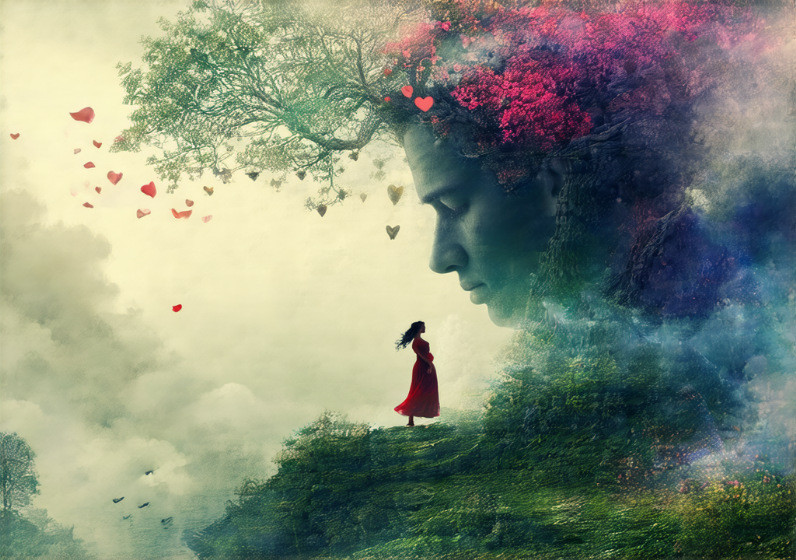
But this merger comes at a cost. To love someone deeply is to accept that they will never be fully known. The face you love is also a mask, a curtain, a door that opens only as far as they wish it to open. There are rooms of the soul they keep locked; there are memories that have faded into myth; there are dreams so private that even their own subconscious only glimpses them in passing. And this unknown territory—the negative space in the portrait—is where the romance lives. If you knew everything about your partner, if you could predict every thought and action, love would calcify into knowledge, and knowledge is a cold master. Wonder requires mystery. To maintain wonder, we must accept that the other remains, in some essential way, an open book.
There is a particular kind of beauty in this incompleteness. Think of a painting you have seen only once, years ago. You remember the colors, the broad strokes, but the details are gone—replaced by your own memory, which has since grown moss and vine over the original image. Your partner is like that painting. Every day, you add to it with new experiences, new conversations, small revelations. The face you love today is not the face you loved a year ago; it is a new composition, built from the same materials but arranged in an entirely different way. To fall in love is to commit to this perpetual renovation of the other. It is to say: I will spend my life reading your face, and I accept that there are pages I may never reach.
And what do we find on those pages? Not just joy, but a new vocabulary for experience. Before love, you might have had only one word for "sadness." After a year with the right partner, you discover ten different shades of it—the blue sadness of early morning coffee; the red, angry sadness that comes after a small argument resolved too quickly; the golden sadness of watching them laugh at something you didn't quite understand. They give you new words for your own life. This is the ontological gift of love: it expands the self. You are no longer the person who existed before this face entered your orbit. You are larger, more nuanced, more strange.
There is also a peculiar kind of freedom in being unseen by the one who knows you best. In our relationships with friends and family, we perform to some degree; we maintain a persona, a reputation. But in deep love—especially in those early, trembling months of falling—the mask slips entirely. We become transparent in ways that would be embarrassing in other contexts. The partner sees your mess, your petty vanities, your unflattering habits. And rather than judge us, they incorporate these flaws into their understanding of the person we are. This is not tolerance; it is a form of grace. It is the acknowledgment that to be fully seen is not a failure but a triumph. We have been authenticated in our fullness.
So what does it mean to fall in love? I would argue that it means to become a philosopher of another's being. You study their face as a hermeneutic text, interpreting gestures and words, cross-referencing past conversations with present behavior. You look for consistency, but you also learn to cherish the inconsistencies—the small contradictions that make a person unique. The partner who is fiercely logical in conversation but sentimental in song. The one who is loud at work but quiet at home. These are not flaws; they are evidence of depth. A flat character is easy to read and boring to love. Complexity is the currency of the soul, and your lover is rich beyond measure.
There is a certain humility required for this kind of wonder. You must be willing to be wrong about them. You must be prepared to revise your understanding repeatedly, to say: I thought I knew you, but I was mistaken. This revision is not a sign of failure; it is the very engine of intimacy. It means you are still looking. It means the face you love remains a live wire, generating new light and heat with every glance.
And what happens when we have read all the pages? When the mystery has been exhausted and the face has become as familiar as our own mirror image? I believe this is where most romances go stale. They mistake knowledge for understanding, familiarity for intimacy. But if you are truly engaged in the ontology of wonder, you will discover that there are always new layers to peel back. The human soul is not a fixed point; it is a process, a becoming. Your partner is still growing, still changing, still writing new chapters into their own story. And your job—your privilege—is to be present for those chapters as they unfold.
There is an old saying that we fall in love with the person who was there when we were at our worst. But I think it goes deeper than that. We fall in love with the person who makes us feel safe enough to be at our worst. The face you love becomes a site of revelation—a place where your own hidden depths surface and are received without judgment. In this mutual unveiling, two strangers become witnesses to each other's humanity.
So here is my final thought: Do not mistake familiarity for intimacy. Keep wondering about the person who shares your bed. Ask them questions you have never asked before. Watch their face when they read a book or stare out a window. Let yourself be surprised by how they react to a song, a meal, a piece of news from the world. Fall in love not with what you think you know, but with what you are still discovering.
Because that is where the magic lives—not in knowing, but in continuing to wonder at the beautiful, mysterious, unfinishable face of the person who has made your life larger and more strange and infinitely richer than it was before they arrived.
And if you look closely enough, you will see it there: a small, quiet light behind their eyes that says I am still becoming. And you will want to be there for every page yet to be written.