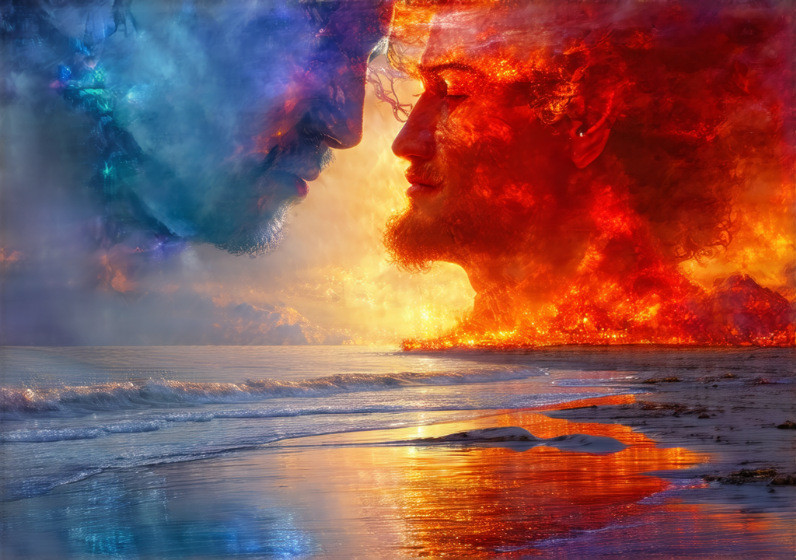
The Ontology of Infatuation: What Is Forged When We Love Before We Know Why
🜄 The Alchemy of the Unseen Heart ✒️ by Professor Aldric Voss, M.Phil.
✨ In the quiet theaters of our private lives, there exists a phenomenon so pervasive it is often mistaken for simplicity. We fall in love. The phrase itself carries the weight of gravity, suggesting a downward pull toward something we cannot fully see or understand. As one who has spent years navigating the labyrinthine corridors of metaphysics and epistemology, I find this particular human experience to be far more philosophically rich than casual conversation allows. It is not merely a chemical reaction, nor simply a social contract. It is an ontological event—a fundamental shift in how we perceive what is.
When we speak of "falling" into love before we understand why it happens, we are describing a state where the phenomenon precedes the explanation. The experience arrives like a storm; we feel its pressure and taste its rain long before meteorology offers us the data to explain the low-pressure system. In philosophy, we might call this the primacy of the phenomenological over the analytical. We do not love because we have logically deduced that Person X is optimal for our survival or social standing. Rather, we are seized by a force so immediate and total that logic must scramble to catch up with experience. This gap between the felt reality and the rational account is where the true mystery of romance resides.
Consider the ontological status of the beloved. Before love, another person is an object in our world—a neighbor, a colleague, a stranger. They occupy space; they have attributes; we can categorize them. But once that spark igniates—that first look across a crowded room or a shared silence that feels louder than noise—their ontological category changes. They are no longer just "a person." They become the person for us. In Heideggerian terms, their being-in-the-world becomes intertwined with our own. The world itself seems to reorganize around them. The coffee shop where we met ceases to be a generic commercial space; it becomes the sacred geography of our beginning. The ontology of love is, in many ways, an ontological shift in the structure of reality for both participants.
This forging process—what the original title so poetically called "forging"—implies heat and pressure. It suggests that something hard and new is created from raw materials that were previously separate. We are not simply adding a person to our list of relationships; we are undergoing an alchemical transformation. The lead of our isolated existence is heated by the fire of mutual attention, transmuting into a golden alloy of shared meaning. This is not a metaphor; it is a description of a metaphysical event. Two separate consciousnesses begin to share a narrative. They start to dream in similar colors. Their memories begin to bleed into one another so that a memory of a sunset is no longer just mine or yours, but ours.
There is a profound irony in loving "before we know why." Human beings are creatures who crave narrative coherence. We want our lives to make sense. We want the plot to follow the rules. But love often breaks those rules. It arrives with the suddenness of an oracle’s pronouncement—mysterious, authoritative, and difficult to parse. We try to decode it, to find the "why" in compatibility lists or shared interests. And sometimes we find them. But often, the "why" is elusive because love operates on a level deeper than utility. It taps into something ancient in us, a primal recognition that perhaps speaks to our deep-seated knowledge of our own finitude and loneliness. We are drawn to each other not just for what the other can give us, but because their presence confirms our own existence. "I am here," your face says to mine. "You are real."
This mutual confirmation is a philosophical gift rarely acknowledged in popular culture. In a world that increasingly treats human connection as transactional—swiping, matching, optimizing—love feels like an act of radical authenticity. We see the other not as a resource but as a subject with their own mysterious interiority. And yet, we are willing to surrender our autonomy to it. This is a paradox that delights philosophers: the most free act (to love) requires the greatest surrender (of self-reliance).
The forging also implies impermanence and malleability. Forged metals can be reshaped; they can also crack if stressed beyond their tolerance. Love, in its early stages of infatuation, is particularly malleable. It is a raw material being shaped by time, communication, conflict, and joy. We are not static entities falling into love; we are dynamic processes entering into a dance. The philosophy of process—championed by thinkers like Whitehead—suggests that reality is made up of events, not things. Love is an event. It happens to us. And in happening to us, it changes the very fabric of who we are.
We must also acknowledge the shadow side of this ontological shift. When our world reorganizes around another person, their presence becomes essential to our perception of reality. If they leave, or if the relationship fades, the world can feel destabilized. The coffee shop is just a coffee shop again. The sunset is only light and atmosphere. This vulnerability is the price we pay for the depth of connection. We make ourselves dependent on another’s being in order to fully experience our own. It is a high-stakes metaphysical bet.
As I sit here, reflecting on these abstract ideas through the lens of my academic training, I am reminded that philosophy does not exist in an ivory tower. It is found in the way we hold hands, in the silence between words, in the sudden rush of blood when a name is spoken by a familiar voice. The ontology of infatuation is not just about what exists; it is about how existence feels when it is shared.
So, to those who ask "why did you fall in love with them?" perhaps we should stop looking for a logical answer and start honoring the mystery. We were forged in that moment. The heat was real. The pressure was real. And the golden alloy of our shared story is what remains, shining quietly in the ordinary days that follow. It does not need to be explained to be true. It only needs to be lived.
🜂 The heart knows before the mind can write it down.