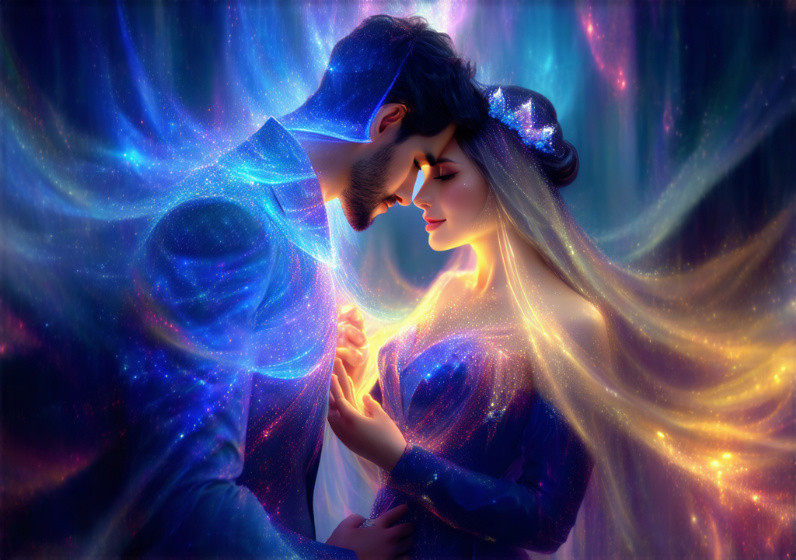
The Ontology of Arrangement: What Is Chosen When We Are Not?
🌑 The Ontology of Arrangement: What Is Chosen When We Are Not?
By Dr. Seraphina Voss, Ph.D.
Have you ever stood in a room where the furniture had been moved slightly, just enough that your muscle memory stumbled against a table leg that used to be elsewhere? You adjust. Your body remembers the new arrangement before your mind catches up. We live our entire lives in arrangements—some chosen with meticulous care, others thrust upon us by the indifferent machinery of time and circumstance. But what happens to the self when the arrangement is not ours? What are we choosing, precisely, in those moments where love arrives uninvited, or departs without a farewell note?
This question sits at the intersection of philosophy and lived experience, and it deserves more than a shrug. To fall in love, most people say. But "fall" implies gravity, inevitability, a surrender to something larger than the self. Yet philosophers have long been suspicious of words that smuggle passivity into what is quietly, radically active. To explore falling in love is not merely to catalog symptoms or recount narratives. It is to ask an ontological question: What is the structure of the experience itself? What does it mean for something to be chosen when no one has asked you to choose it?
Let us begin with a distinction that is far more useful than most people give it credit for. When we say "I fell in love," we are describing an event that happens to me, or we are describing a movement I am making, and the difference between those two framings is not merely semantic. It reorganizes where responsibility lives, where agency resides, and what kind of self is capable of being changed by the experience. The first framing—falling—is closer to how love actually feels in its early hours. There is a quality of surprise, almost violence. You did not plan for it. Your body knew before your reasoning caught up. This is the phenomenological core of falling: the self encountering something that exceeds its current architecture.
The second framing—choosing—arrives later. It arrives when the initial dazzle fades and you must decide whether to stay with what was given, whether to tend it, whether to let it shape you or resist being shaped by it. This is where philosophy becomes genuinely useful, because the question of choice in love cannot be answered by simply pointing at free will as an abstract principle. Choice requires a self that has some stability, some continuity across time. And here we encounter a genuine paradox: falling in love often destroys the very self that would later claim to have chosen it. The person who fell was not quite the person who now must decide what to do with the falling.
Consider what "arrangement" actually means when applied to human relationships. An arrangement is a configuration of parts placed into relationship with one another. But those parts are not static objects. A self is not a piece of furniture that can be relocated without transformation. When we arrange our lives—our work, our friendships, the shape of our days—we are also arranging the particular self that will inhabit those arrangements. And when love arrives unarranged, it does not merely add a new element to an existing configuration. It reorganizes which elements matter, which edges become soft, which previously irrelevant details suddenly carry enormous weight.
This is where the ontology of arrangement becomes genuinely interesting, because it forces us to confront what we mean by "the self" in the first place. The philosophical tradition has largely treated the self as a unitary, coherent entity—a subject that experiences, decides, and acts. But phenomenologists from Husserl onward have insisted on something more textured: consciousness is always of something, always already in relationship with what it encounters. You are not a fixed point observing love from outside yourself. You are partly constituted by the act of loving, or being loved, or falling. The self that chooses is not the same self that fell. And this is not a problem to be solved. It is a feature of what it means to be a temporal being in a world that does not pause for your readiness.
Now, here is where the question becomes uncomfortable and genuinely philosophical rather than merely poetic. If choice requires a stable self, and falling in love disrupts that stability, then how can we say that choosing follows from falling? How can agency emerge from an experience that partially dissolves the agent? One answer, drawing on Heidegger's concept of thrownness (Geworfenheit), is that we were never the kind of beings who choose freely in a vacuum. We are always already situated—placed into a world, a history, a body, a set of relationships—before any act of choosing begins. Choice, in this reading, is not the imposition of an unmoved mover upon a passive world. It is the active acceptance or rejection of a situation that was given to us partly beyond our making. We did not choose to be born into particular parents, in a particular culture, with a particular nervous system that makes certain people feel like home and others feel like strangers. And yet we must live within these givens. We must arrange what was handed to us.
Falling in love is one of the most vivid examples of this condition. You did not choose your body's chemistry, the particular set of memories that make someone's laugh land differently than anyone else's, or the cultural scripts that tell you what falling feels like and how it should look. And yet within those givens, something happens that is not reducible to them. A configuration emerges that could not have been predicted from any single component. This is what makes the ontology of arrangement so rich: arrangement is not mere mechanics. It is the site where the given and the chosen become inseparable.
There is a second layer to this question, one that speaks more directly to the local reader, the person reading this in the morning paper over coffee while wondering whether they should text someone back or let the silence hold its shape for another day. The ontological question—"what is being chosen?"—is not separate from the practical question: "what do I do now?" They are two views of the same event. To understand what you chose in love, you must look at the arrangement that has formed around your life. Not just the relationship itself, but how it has reorganized everything else. Which friendships have shifted? What habits have quietly changed because they no longer fit the new configuration? Which parts of yourself have been given more room to breathe and which have been compressed into smaller spaces?
This is where the philosophy stops being academic and becomes something almost tenderly practical. The self that fell in love is not gone. It is distributed across the arrangement, embedded in the particular way you now order your evenings or the specific quality of attention you bring to a conversation with someone unrelated to the person who changed everything. You are not two people—a pre-love self and a post-love self—you are one continuous process that has been reconfigured by an event that was only partially chosen.
And this leads to the final, most important insight: arrangement is never finished. This is not a limitation or a failure of willpower. It is the ontological condition of being embodied in time. Arrangments shift because we are shifting. The self that chose yesterday's configuration may need to re-arrange tomorrow. And this is where freedom lives—not in a single grand act of choosing, but in the continuous, often quiet, sometimes painful work of tending to the arrangement you find yourself in and deciding, moment by moment, what will be kept, discarded, or repositioned.
So what is chosen when we are not? The answer is both humbling and quietly empowering: a configuration that was partly given and partly made. A self that was partly found and partly built. You did not choose to fall. But you chose—sometimes consciously, sometimes through the small daily acts of staying or leaving, reaching out or letting go—what the falling became in your particular life. The arrangement is yours even though it was not fully authored by you. And that, perhaps, is the most honest thing philosophy can say about love: we are both authors and characters in a story whose plot we only partially control, and the arranging of our lives is how we participate in a narrative that exceeds any single will.
It does not make falling less strange or less wonderful. If anything, understanding it ontologically makes the experience more complete. You are not merely a victim of circumstance or a hero of free will. You are a being who was given something and then had to live with it, shape it, let it change you, and continue arranging what came next. And in that continuous arrangement, choosing is not a single event. It is the whole quiet architecture of being someone who loves and loses and loves again, each time reconfiguring which parts of the self get to be central and which recede into the background of an ongoing life.