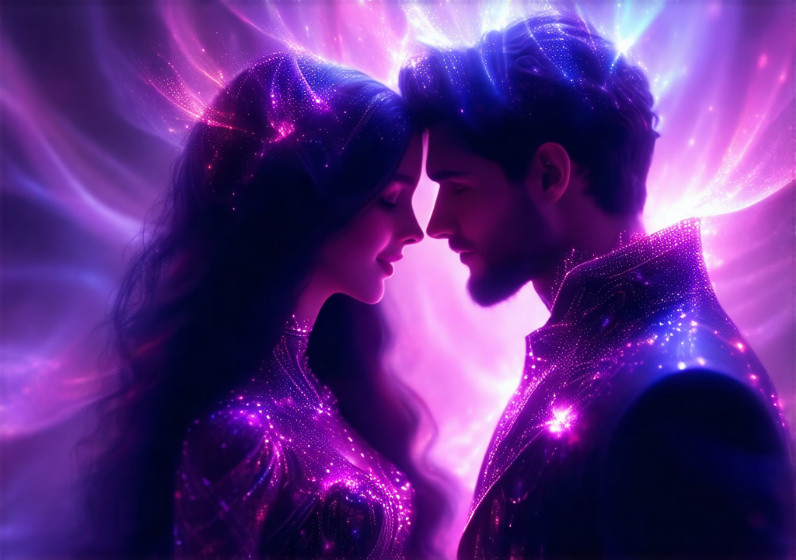
The Neuroscience of Nostalgia: Why New Faces Can Feel Familiar
✦ The Neurochemistry of Longing: Why Strangers Carry the Scent of Memory ✦
By Dr. Elara Voss, M.A.
There is a peculiar alchemy that occurs when memory and perception collide. You stand in a quiet coffee shop on a rainy Tuesday, perhaps lost in thought, sipping something warm while watching the condensation bead down the glass. Suddenly, a stranger walks in wearing a coat of a specific shade of autumn amber. For a fleeting second—so brief it is almost imperceptible—you feel a profound sense of recognition. A warmth blooms behind your ribs. A phantom melody hums in your chest. You are certain this person has known you for years; that you have shared long, deep conversations by candlelight. And then the moment passes, and they are just a stranger again.
This phenomenon is not merely poetic fancy. It is a complex neurological event where the brain, in its endless quest for pattern recognition and emotional continuity, momentarily borrows the texture of the familiar from the landscape of the past. We call it nostalgia, but it is something far more mechanical and magical: it is the mind’s way of anchoring the present to a self that already exists.
To understand why new faces can feel so achingly familiar, we must first dissect what nostalgia actually is. Philosophers have long debated whether memory is an act of preservation or reconstruction. In neuroscience, the answer leans heavily toward the latter. Memory is not a video recording stored on a shelf; it is a living, breathing narrative that is rebuilt every time we recall it. When we remember our college years or a summer evening from two decades ago, we are not retrieving a file. We are re-simulating an experience using a patchwork of sensory fragments: the smell of rain, the quality of light, the cadence of a friend’s laugh.
The brain is a prediction machine. It constantly generates models of what should happen next based on past experiences to reduce cognitive load and ensure survival. When we encounter a new face in a familiar setting, the hippocampus—the organ central to memory formation—cross-references this input against our vast archive of stored impressions. If certain features align with a general schema (for example, "a kind-looking woman in a red jacket"), the brain may superimpose emotional data from related memories onto the current perception. The new face becomes a trigger. It does not simply represent itself; it represents a memory, or even several overlapping memories at once.
This is where the chemistry of longing enters the picture. Nostalgia is driven by a cocktail of neurochemicals that create a state of bittersweet pleasure. Key among these are dopamine and serotonin. Dopamine, often called the reward chemical, is released not just when we get what we want, but when we anticipate it or recall past rewards. Serotonin stabilizes mood and contributes to feelings of contentment. When a new face triggers a nostalgic response, these neurotransmitters flood the brain, creating a warm, enveloping sensation that we interpret as "knowing" someone or feeling connected to them.
But why does this happen with new faces specifically? Why don’t we feel this same familiar warmth when looking at our own children or close friends? The answer lies in the concept of emotional resonance versus semantic memory. With people we know well, we have specific episodic memories: "We had lunch on Tuesday; she ordered soup." These are concrete, factual, and grounded. We recognize them through direct association. But with strangers, recognition must be analogical. The brain looks for thematic or aesthetic parallels. A stranger’s smile might mirror the curvature of a grandmother’s smile. Their voice might carry the same timbre as an old lover’s whisper. The brain bridges the gap between "this person" and "that memory," creating a synthetic bond that feels authentic because the emotional response is genuine, even if the reference point is borrowed.
Consider the role of sensory priming in this process. Our perception is never neutral; it is always filtered through our current internal state. If you are feeling lonely or reflective, your brain primes itself to seek connection and meaning. You become more attuned to faces that radiate warmth or intelligence because your neural networks are actively looking for those qualities to soothe a void. The new face becomes a canvas upon which the mind projects its longing for intimacy. This is not deception; it is the mind’s creative act of finding companionship in an isolated world.
There is also a temporal dimension to this effect. Nostalgia is inherently backward-looking, yet it serves a forward-facing purpose. Psychologists suggest that nostalgia helps us cope with uncertainty and change by reminding us of our own continuity as persons over time. When we feel a flash of familiarity with a stranger, we are essentially confirming our own existence across time. We are saying to ourselves: I have felt this before; I am the same person who loved those other moments. The new face is merely the lens through which we view that continuity.
Interestingly, this phenomenon varies greatly from person to person. Those with high trait anxiety or a strong need for belonging may experience these flashes of false familiarity more frequently and intensely. Conversely, individuals who have cultivated a strong sense of self-reliance or who practice mindfulness may distinguish between actual recognition and imaginative projection more easily. This suggests that the "falling in love" aspect of nostalgia is not just neurological but also psychological—a matter of how we relate to our own interiority.
In literature and art, this conflation of the new and the old has been a central theme for centuries. Poets have written of "strangers who feel like brothers," of cities that smell like childhood homes, of songs that make us weep without knowing why. These artistic expressions capture what neuroscience is now beginning to map: the human mind does not experience reality as a series of discrete, isolated moments. It experiences it as a flowing river where past and present mix, where every new leaf carries the green of last spring, where every new face carries the warmth of all the faces that have ever loved us.
This has profound implications for how we understand love itself. If nostalgia can make a stranger feel like an old friend, then perhaps love is less about finding someone who perfectly matches our preferences and more about creating the conditions under which familiarity becomes possible. We fall in love not just with a person’s attributes, but with the story our mind begins to tell about them. The initial spark of attraction is often a nostalgic illusion—a moment where the brain mistakes novelty for recognition. Over time, if we choose to engage deeply and consistently, that borrowed warmth can transform into genuine, shared history. The familiar becomes real not because it was there before, but because we build it together until it belongs in our personal archive.
So, when you next stand in a crowded room or walk down a busy street, and a stranger’s face suddenly strikes you with the weight of a thousand memories, do not dismiss it as mere imagination. Recognize it for what it is: your mind reaching across time to hold onto itself. It is a testament to the richness of your inner life, the depth of your emotional capacity, and the brain’s magnificent ability to weave meaning out of the chaos of sensory input.
In a world that often feels fragmented and transient, these flashes of phantom familiarity are small acts of philosophical repair. They remind us that we are not isolated observers but participants in an ongoing narrative. The new face is a question: Do you remember who you were? And the feeling of warmth that answers it is the promise that you still can. It is the neuroscience of longing, and it is beautiful precisely because it bridges the gap between the person you have been and the person you are becoming. In that bridge lies not just memory, but hope—the quiet, persistent belief that connection is possible, even with someone you have never met, because somewhere in your mind, they already do.