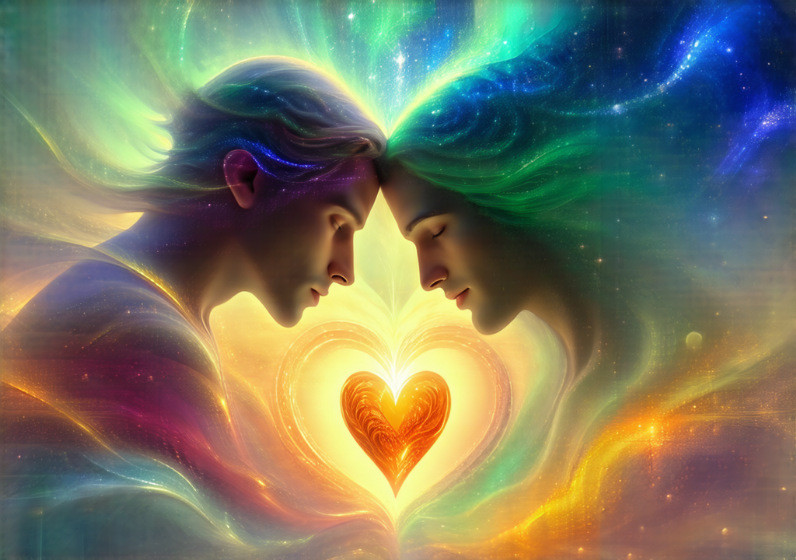
The Mystery of the 'Perfect Fit': Why Some Bonds Feel Inevitable
The Mystery of the ‘Perfect Fit’: Why Some Bonds Feel Inevitable
By Aurelia Voss, M.A. Philosophy
✦ ✧ ☽
There is a particular quality to certain encounters that defies simple explanation. Two people meet—perhaps by chance, perhaps through the quiet orchestration of circumstance—and something clicks. Not with the satisfying snap of a well-oiled mechanism, but with the deeper, more resonant hum of two tuning forks struck in unison. The world narrows. Time seems to fold in on itself. And both parties are left with a strange, almost sacred certainty: this was not merely a meeting. It was an inevitability.
Philosophers have long been fascinated by the experience of love, yet the specific phenomenon of that “perfect fit”—the sense that two distinct individuals were somehow destined to find one another—resists clean categorization. Is it a metaphor? A cultural myth we impose upon chance? Or is there something genuinely metaphysical at work in the space between two people who seem to have been waiting for each other across time and space? To explore this question, we must walk through several philosophical landscapes: the nature of personal identity, the role of narrative in human experience, and the ancient but still vital idea that souls may be, in some sense, composed of fragments.
The Paradox of Uniqueness
To feel a “perfect fit” with another person is to encounter a profound paradox. Each of us is, by any honest accounting, an irreducibly unique configuration of memories, desires, quirks, and silences. No two human beings share the same interior landscape. And yet, in certain relationships, we experience not just similarity but complementarity—a sense that the other person completes something in us, fills a shape we didn’t know was hollow until they stepped into it.
Aristotle would recognize this as an echo of his concept of eudaimonia, though he framed it more in terms of virtue and self-sufficiency than romantic union. For Aristotle, the good life was achieved through the cultivation of reason and the formation of deep friendships (philia). He might have said that a “perfect fit” is simply two well-ordered souls recognizing each other’s excellence. The fit is not magic; it is the natural gravitation of like toward like, of completed toward completed.
But this rationalist reading feels insufficient for many of us. We don’t experience love as a logical conclusion drawn from observed virtues. We experience it more like a revelation. It arrives before we can fully account for why. The other person becomes not just admirable but familiar in a way that transcends knowledge. You have never met this person before, and yet there is something about them that feels as old and true as your own first memory of light.
This tension between reason and revelation sits at the heart of the mystery. If love were purely rational, it would be explainable. If it were purely irrational, it would be ungrounded. The “perfect fit” lives in the fertile middle: a feeling that is not reducible to logic but is also not arbitrary. It has texture. It has weight.
Narrative Identity and the Story We Tell Ourselves
One of the most important insights from contemporary philosophy—particularly from thinkers like Paul Ricœur, who explored narrative identity in his work on selfhood—is that we are not simply collections of atoms or neurons. We are stories. We construct our sense of self through the narratives we tell about our own lives. And here is where the “perfect fit” begins to make philosophical sense.
When we meet someone who resonates with us, what often happens is that their presence validates and extends a story we have already begun telling ourselves. Perhaps you had been quietly seeking a partner who could understand your particular way of grieving. Or perhaps you had built an identity around being the reliable one, the steady anchor—and then you meet someone whose chaos beautifully complements your order. The “fit” is not just about compatibility of traits; it is about narrative coherence. The other person becomes a character in your story who makes the plot make sense.
This does not mean the feeling is fabricated or self-deceptive. Rather, it suggests that human beings are fundamentally meaning-making creatures, and that love is one of our most powerful engines for creating meaning. The “inevitability” we feel may be the experience of a story finally finding its next chapter. We did not invent the fit; we recognized it. And recognition, in philosophy, is often treated as more profound than invention. You do not create truth; you discover it.
The Platonic Echo: Souls Pre-Existing
Perhaps no philosophical tradition has taken the “perfect fit” more seriously than Platonism. In the Symposium, Plato offers a beautiful myth about love: that all human beings were originally whole, spherical beings made of two halves joined together—male-male, female-female, or male-female. At some point in cosmic history, these wholes were split apart, and ever since, each half has been searching the world for its other half to become whole again.
This is, on one level, a charming myth. On another, it captures something deeply real about human experience: the sense that we are incomplete until we find the person who makes us feel complete. The “perfect fit” is not two perfect people clicking together; it is two imperfect people discovering that their imperfections interlock like puzzle pieces.
For Plato, love (eros) was a form of knowledge. To fall in love with someone and feel that this bond is inevitable is to glimpse a truth about the structure of reality—that wholeness exists, that fragmentation is not our final condition, and that reconnection is possible. The “mystery” of the perfect fit is, in this reading, not a failure of understanding but an invitation to understand more deeply. It points us toward something larger than ourselves: the idea that we are all, in some sense, seekers.
Contingency and Grace
A more modern philosophical lens—perhaps drawn from existentialist or phenomenological traditions—might frame the “perfect fit” as a form of contingency made meaningful. We did not choose to be born. We did not choose where we grew up, what wounds we carried, or the particular configuration of our desires. These are all contingent facts about us: they could have been otherwise. And yet, when we meet someone who fits so well that it feels inevitable, we experience contingency as if it were necessity. The fact that we met—given all the ways we might not have—suddenly feels like it was the only way things could have turned out.
This is a powerful philosophical move: to take something that is purely contingent and feel it as if it were necessary. It does not change the facts of the world, but it transforms our experience of them. The “mystery” is real because our experience of meaning is real. We are not just physical beings; we are beings for whom the world has a certain quality—warmth, resonance, narrative shape—and love is one of the primary ways that quality manifests.
There is also an element of grace here, if you will use that word in its philosophical (not necessarily theological) sense: something given freely, not earned, not fully explained. The “perfect fit” often arrives unbidden and unexplained. You cannot force it. You can create conditions for it—openness, vulnerability, time—but the actual moment of connection feels like a gift from an anonymous giver. It is contingent in origin but experienced as given. And that tension between contingency and given-ness is where much of human meaning lives.
The Ongoing Mystery
It would be easy to resolve this mystery by reducing it: the “perfect fit” is just chemistry, or just shared values, or just a story we tell ourselves. And each of those reductions has some truth in them. Chemistry matters. Shared values matter. Narrative matters. But reduction, as any philosopher will tell you, never captures the fullness of an experience. A sunset can be fully explained by atmospheric optics and photoreceptor biology, but that explanation does not erase its beauty. Likewise, a “perfect fit” can be analyzed in terms of neurochemistry and social psychology, but that analysis does not explain why it feels inevitable.
The mystery persists because the experience is richer than any single explanatory framework. It draws on our bodies, our stories, our memories, our hopes, and perhaps—though this is a more speculative claim—our deeper orientation toward wholeness. The “perfect fit” is not a thing that happens to us; it is something we participate in. We bring to the encounter everything we are: our wounds, our longings, our unspoken questions. And when two such complete-yet-incomplete beings meet under the right conditions, something occurs that feels less like an event and more like a recognition.
And perhaps that is what inevitability really means in this context: not that the bond was predetermined by some cosmic script, but that it felt so true to who we are that it seemed as if it had been waiting for us all along. The mystery is not a problem to be solved. It is an experience to be inhabited. And like all great philosophical and human experiences, its value lies not in our ability to explain it, but in our willingness to let it change us.
☽ ✧ ✦