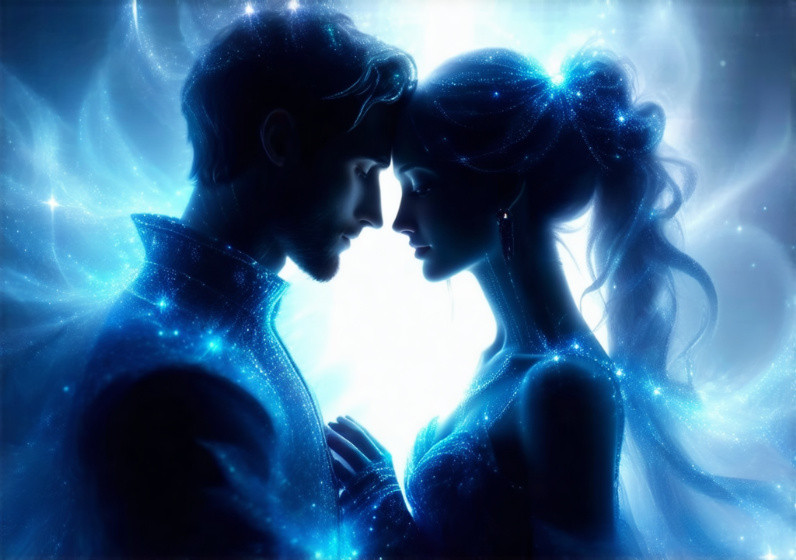
The Dopamine vs. Oxytocin Battle: Why 'Falling in Love' Fades but Synchrony Grows
The Dopamine vs. Oxytocin Battle: Why 'Falling in Love' Fades but Synchrony Grows 🌹✨
By Aurelia Voss, M.A.
Have you ever wondered why that intoxicating, breathless feeling of "falling in love" seems to dissolve into something quieter—and perhaps more profound—after the initial months? We're taught, through films and pop culture, that true love is a permanent state of euphoria. When it fades, we assume the relationship has failed. But what if the fading isn't a sign of loss, but rather evidence of an ancient biological transition from a chemical storm to a quiet resonance?
This shift—between dopamine-driven excitement and oxytocin-driven attachment—is not just neurochemistry; it's philosophy in motion. It asks us to rethink what love actually is: a permanent high, or a deepening alignment?
The Chemistry of Falling 🎇🧪
"Falling in love" is, physiologically, a state of chemical intoxication. Dopamine reigns supreme. This neurotransmitter is not simply about pleasure; it's the brain's reward and motivation system. It drives craving, anticipation, and goal-directed behavior. When we fall in love, dopamine floods the brain's reward centers—the same regions activated by food, money, or even cocaine.
Philosophers have long wrestled with this: Is desire a form of lack? Plato, in his Symposium, described eros as a yearning for wholeness—a feeling that we are incomplete and seeking our other half. Dopamine embodies this: it is the neurochemical signature of wanting. The beloved becomes a target, a goal. We think about them constantly not because they satisfy us completely, but because they represent an infinite possibility.
This state is thrilling precisely because it's unstable. The brain craves novelty and prediction error—the gap between expectation and reality. In early love, every interaction carries surprise: Will they call? What will they say? Is this real? This uncertainty keeps dopamine firing in loops that feel like electric charge.
But here's the philosophical twist: Dopamine-driven love is inherently about self. It's about what I want, how I feel, what my desire tells me about myself. The beloved becomes a mirror for our own longing.
And mirrors crack under sustained light. As familiarity grows—inevitably—the prediction errors shrink. We know their coffee order. We predict their reactions. The novelty fades. Dopamine's signal weakens because the brain has learned the pattern.
Is that the end of love? Or merely a change in its substance?
From Wanting to Knowing: Oxytocin and the Quiet Architecture of Love 🕯️🤝
As dopamine recedes, another chemical system rises: oxytocin (along with vasopressin and related peptides). Where dopamine is about craving, oxytocin is about bonding. It reduces anxiety, builds trust, and creates a sense of "we."
Oxytocin doesn't make you want the other person in the same ravenous way. It makes you feel safe with them. It turns two separate selves into a shared space. Philosophers like Levinas described this as an ethical relationship: love becomes a recognition of the other's irreducible difference, and a commitment to stand before them without consuming or merging.
This is the quiet architecture. No fireworks. Just presence. A hand on a shoulder in traffic. The way they leave the light on when you're tired. These micro-moments accumulate into something dopamine can't provide: synchrony.
Synchrony here isn't mind-reading or identical thoughts. It's rhythmic alignment—like two clocks that have drifted apart and slowly, through years of small corrections, begin to tick in near-unison. Your breathing matches theirs during a shared silence. You finish each other's sentences not because you're the same person, but because your attention has woven into a shared pattern.
This is what I'd call "growing love." It doesn't fade; it deepens. It moves from intensity to resonance.
The Philosophical Shift: From Eros to Philia (and Beyond) 📜🌿
Greek philosophy offers a useful map here. Eros—the passionate, desiring love—is the dopamine phase. It's beautiful but unstable, often selfish in its orientation. Philia—friendship, mutual regard, shared activity—is closer to the oxytocin phase. It's calmer, more reciprocal, and less dependent on novelty.
But there's a third: Agape—a selfless, almost unconditional love that sees the other clearly, flaws and all, without needing them to be idealized. Oxytocin-driven synchrony edges toward agape because it requires seeing the actual person, not the fantasy the dopamine loop created.
This matters philosophically because most of our cultural narratives privilege eros as "true" love. The oxytocin phase gets dismissed as "settling." But if we think about it: which is more courageous? To stay in a state of perpetual longing (which can become addictive and self-centered) or to build something that requires daily, unglamorous commitment?
Kierkegaard distinguished between the aesthetic stage (driven by pleasure and novelty—dopamine) and the ethical/religious stages (commitment and meaning—oxytocin/agape). "Falling in love" is aesthetic. "Growing together" is ethical work. And while work sounds less romantic than a high, it's where genuine human connection becomes possible.
Synchrony: The Hidden Geometry of Deep Love 🌀🌟
Let's linger on synchrony, because it's the concept that reframes everything.
Synchrony isn't agreement. You don't have to share values or even enjoy the same books. Synchrony is a rhythmic phenomenon. It's the way two separate systems begin to coordinate—not by merging, but by adjusting. A couple who has been together for twenty years may argue about politics over dinner, but their body language tells a different story: one leans in when the other softens a sentence; both reach for a glass at the same moment without looking.
This is what philosophers like Merleau-Ponty called "embodied knowing." You don't understand your partner through propositions ("they think X about Y"). You understand them through shared, repeated micro-adjustments of attention and affect. Over time, these adjustments create a kind of invisible choreography. A new person watching you interact would see two individuals; but from the inside, it feels like one rhythm with two voices.
This is why "falling" fades—because falling is about momentum, which must slow down to become balance. Synchrony isn't a peak experience; it's a sustained state. It doesn't announce itself. You only notice its absence when it breaks.
Why This Matters Beyond Romance 💌🧠
This dopamine-to-oxytocin shift isn't limited to couples. Friendships, parent-child bonds, even professional collaborations follow similar arcs: initial excitement (dopamine) gives way to reliable resonance (oxytocin/synchrony). The ones who mistake the fading high for failed relationships will constantly chase novelty—new partners, new friends, new projects—without ever building depth.
And here's a gentle warning: recognizing this shift doesn't mean settling for mediocrity. If synchrony has actually broken—if there's no rhythm left because one person stopped adjusting—the oxytocin bond may need repair or replacement. The key is to distinguish between the natural fading of dopamine (which signals growth) and the genuine absence of connection (which signals neglect).
Philosophically, this mirrors the difference between change (a sign of life) and loss (a sign of entropy). Love that fades in intensity but grows in depth is change. Love that simply goes flat—where neither person adjusts for the other anymore—is loss.
A Philosophical Reframe: Love as Alignment, Not Intensity 🌌🕊️
So what should we take from this? If you're in a relationship where the butterflies have calmed into something quieter, don't immediately reach for the exit door (or the latest novel) looking for the old spark. Ask instead: Is there rhythm here? Are we adjusting to each other's rhythms? Do I feel with them as much as about them?
If yes—congratulations. You're in the deeper phase. The one that philosophers would recognize as more aligned with what love ought to be: not a state of perpetual craving, but a practice of mutual presence.
Dopamine gets us started. Oxytocin keeps us together. Synchrony makes the "together" meaningful. And understanding this shift—embracing it rather than mourning it—is perhaps one of the quietest philosophical insights love can offer: that depth is not the absence of excitement, but its long-term consequence.
The fire burns bright and brief. The hearth glows steady and warm. And where I want to be most… isn't in the blaze. It's in the glow. 🔥🕯️