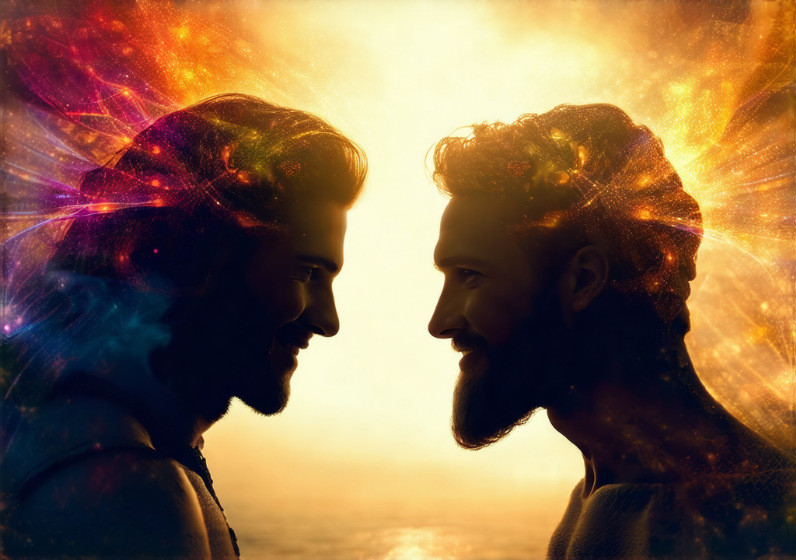
The Cartography of the Heart: Mapping the Shift from Friend to Lover
🌒 The Cartography of the Heart 🌒
By Elowen Voss, M.A.
There is a cartographer’s old maxim that maps are never the territory. We draw them to navigate, but in drawing, we inevitably flatten, simplify, and imagine what isn’t there. The heart works the same way. What feels like love—tender, warm, inevitable—is often a map of memory: a terrain reconstructed from past longings, old friendships, and stories we’ve already told ourselves about who we are when someone else is in the room. To understand falling in love, it helps to stop treating it as an event that happens to us, and start treating it as a landscape we help create.
This is not a cynical reading of romance; it’s a philosophical one. The question worth asking isn’t “do I love this person?” but rather: what does loving them require me to become? Because the shift from friend to lover changes the map entirely—and what was once familiar terrain becomes, almost overnight, something foreign and luminous at the same time.
I. The Friend as a Known Map
Friendship is a geography of low stakes. You know where things are. You’ve walked these paths together so many times that the terrain feels almost like your own body—familiar, predictable, safe. In philosophy we speak of the habitus, the accumulated dispositions through which a person comes to inhabit the world. Friendship builds habitus: you develop shared rhythms, private jokes, comfortable silences. The other person becomes, in a sense, an extension of your own interior life.
This is both friendship’s greatest gift and its subtle trap. Because everything is already mapped, there is little need to wonder. You know how they’ll react when you’re sad. You know what they’ll say when you share good news. The world stays legible. And because it stays legible, the friend remains, in a meaningful sense, yours—a stable point of reference in your own self-understanding.
Loving someone is not merely adding intensity to this map. It’s drawing an entirely new one. Suddenly the familiar paths feel strange. The private jokes carry different weight. The comfortable silence becomes something that needs interpreting. You find yourself watching them, not with recognition, but with a kind of hungry curiosity—the same feeling you’d have standing at the edge of a forest you’ve never entered.
II. The Moment the Map Folds Inward
Falling in love often begins as an uninvited revision. A friend says something ordinary—“You’re funny when you get flustered,” for instance—and suddenly the sentence lands somewhere deeper than you expected. You feel seen not as yourself, but as a self that you didn’t know existed until they named it.
Philosophers call this kind of experience revelation: something previously hidden is disclosed, and in being disclosed, changes what it was. The friend’s words don’t just describe you; they help create the version of you that can be described. This is a crucial distinction. We tend to think love confirms who we already are. But more often than not, love discloses a self we had no name for until someone else saw it.
This is why the shift from friend to lover feels so destabilizing. It’s not just that feelings have changed. It’s that you’ve been offered a new cartography of yourself—and accepting that map means admitting that part of who you thought was fixed was, in fact, still being drawn.
III. Love as an Act of Revision
A useful philosophical lens here comes from the tradition we call phenomenology—the study of experience as it presents itself to consciousness. In phenomenology, attention is not passive reception; it’s a form of creation. What you attend to becomes real in your world. When you begin to love someone, you start attending to them differently. You notice things you never noticed before: the way their hand moves when they’re thinking, how they soften or sharpen depending on who’s listening, what they laugh at and why it matters to them.
This attention is not neutral. It shapes the person you come to love, just as a cartographer’s choices shape the map. You are not discovering a fixed truth about someone else; you are co-authoring a story of who they are in relation to you—and who you are in relation to them.
This sounds almost flattering: that love is creative, generative. But it also carries a quiet responsibility. If your attention helps create the person you love, then loving well means learning to attend honestly—to resist turning someone into a character in a story you already believe. The temptation in falling in love is to map them according to what you need or want them to be. Philosophy asks us to be more careful: Are you seeing this person, or are you seeing the projection of yourself wearing their face?
IV. The Fear at the Edge of the New Map
There’s a reason the shift from friend to lover is so often accompanied by fear. You’re leaving familiar terrain for something unmapped. And in an unmapped landscape, every step carries the possibility of error: you might misread, overstep, lose the other person, or lose yourself.
A few centuries ago, philosophers began to articulate what we now call vulnerability—the condition of being open to loss without guaranteeing its absence. Friendship protects against some kinds of vulnerability because the stakes are lower and the map is more stable. Love opens you to a deeper kind: you become dependent on someone’s continued attention in a way that friendship rarely requires, and your self-understanding becomes partly bound up with how you appear to them.
This is not a reason to avoid love. It’s a reason to understand it honestly. To love someone is to say, in effect: I am willing to let my map be redrawn by another person’s gaze. That is an act of philosophical courage as much as emotional risk.
V. What the Map Is For
A good map doesn’t replace walking; it helps you walk with intention. The same is true for understanding love. When we recognize that falling in love involves revision, attention, and co-creation, we stop treating romance as a mystery to be solved or a feeling to be chased. Instead, we can treat it as an ongoing practice: learning how to attend well, how to revise honestly, how to hold both the person you’re loving and the self that’s being changed by that love.
And perhaps this is what makes the shift from friend to lover so quietly profound. It asks us to do something philosophically rare: to let a relationship change who we are without pretending it didn’t. To draw a new map, knowing it will be revised again. To love not as a fixed truth but as a living geography—always in motion, always partially unknown, and somehow more real for being so.
The heart is never fully mapped. But that doesn’t make the journey less worth taking. It makes it the reason to keep walking. 🗺️