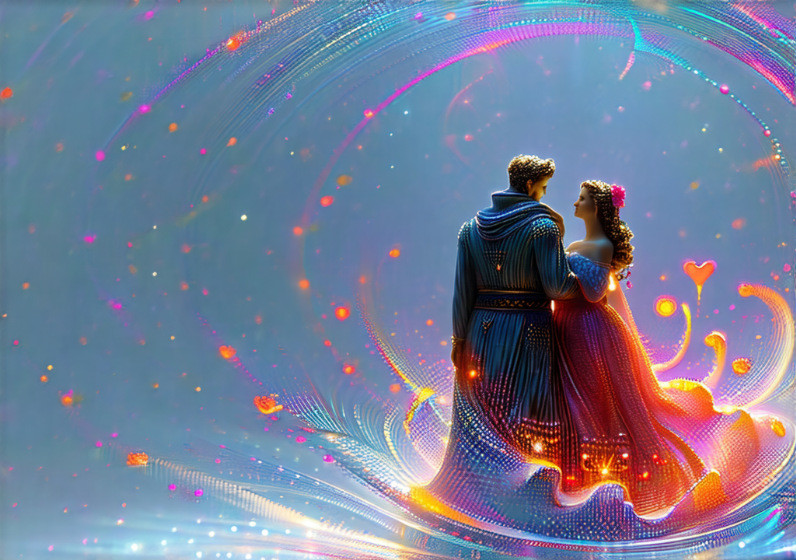
Stop Waiting for the Right Moment – It Doesn’t Exist (Here’s What to Do)
The Courage of Imperfect Love 💕
By Elena Marlowe, Ph.D.
There is a quiet tragedy that plays out in the lives of people who are not unloving, but cautious. They study their feelings with a magnifying glass. They measure their compatibility like scientists weighing chemicals. And they wait—for the right moment to fall in love. The perfect evening. The flawless first date. The alignment of stars, schedules, and self-esteem that will make everything finally click.
They believe that if they just wait long enough, love will arrive wearing a white glove, holding a bouquet, and saying, “Congratulations, you have met the threshold.”
But here is what philosophy has known for centuries: there is no right moment to fall in love. There never was. The right moment is a myth we invented because uncertainty feels worse than risk. And so, instead of stepping toward connection, we build elaborate waiting rooms in our heads—rooms filled with conditions that must be met before we allow ourselves to want another person fully.
This article explores why we wait for the perfect moment, what that waiting really costs us, and what we can do instead if we are willing to embrace a more honest, more human way of loving.
The Myth of the Right Moment ✨
The idea that there is such a thing as “the right moment” comes from a very particular way of thinking about time, risk, and identity. It assumes that love is an event—something that happens to us when conditions align, like lightning striking a tall building. But love is not lightning. Love is more like tending a garden: it requires showing up in the rain, pulling weeds you didn’t plant, and trusting that seeds buried weeks ago will one day break through the soil.
We also assume that if we are not ready—emotionally stable, financially secure, free of old wounds—we don’t deserve to fall in love. So we postpone. We tell ourselves, “Once I’ve figured myself out, then I’ll be someone who can truly give and receive love.” And in our waiting, we become the person who is always about to begin.
Philosophers have long noted this paradox of preparation: we prepare so thoroughly for life that we spend most of it preparing instead of living. Søren Kierkegaard spoke of “aesthetic” modes of being—lives organized around pleasure, image, and endless possibility. The aesthetic person always wants the next experience to be better than the last. They curate their lives like a gallery owner selecting paintings for display. And in that curation, they never fully inhabit any single moment.
Falling in love requires the opposite: inhabiting. Letting another person see you mid-sentence, unstyled, unsure. Letting your nervous system register that this stranger is safe enough to be vulnerable with. It doesn’t require perfection. It requires presence.
Why We Wait 🕊️
So why do we wait for the right moment? Several quiet forces are at work.
One: We confuse readiness with certainty.
We want to know that love will last before we commit to it. But no one can guarantee that—neither you nor your partner. Love is not a contract; it is a practice. You don’t sign the contract and then live the practice. You live the practice, and that living is the contract. Waiting for certainty means waiting forever, because certainty only arrives after the fact.
Two: We protect our self-image.
To fall in love is to be seen. And being seen is risky. If you open yourself fully to someone—and they don’t return it in the same measure—you have to reconstruct your understanding of who you are. For some people, that reconstruction feels too expensive. So they stay in a state where they want love but haven’t fully chosen it. It’s safer to almost-love than to actually love and be left with evidence of what went wrong.
Three: We romanticize the beginning.
We think falling in love is the peak experience—the highest moment, after which everything must inevitably decline. So we hold onto that first spark as proof that “real” love exists somewhere, just around the corner. But most lovers know that the spark fades or changes shape. What remains is often quieter: two people choosing each other on a Tuesday morning when neither feels particularly poetic. That quiet choosing is not less than the spark. It is more.
Four: We outsource our courage.
We wait for external conditions to give us permission to begin. The job has to be stable. The apartment has to be fixed. The ex has to be fully processed. The friends have to approve. And while we wait for all these things to align, time passes, and the person we wanted to love is living a life that no longer includes us.
What to Do Instead 🌱
If there is no right moment—only moments that are good enough, and people who are willing to be imperfectly loved with you—then what does it mean to actually fall in love? Here are some philosophical, practical, and quietly radical suggestions.
1. Start smaller than you think.
You don’t need a grand gesture or a life-changing confession. Falling in love can begin with asking someone how their week was—and meaning it. It begins with remembering the small thing they mentioned three days ago and bringing it up again. It begins with letting yourself be curious about another person without requiring that curiosity to become something specific. Curiosity is not commitment, but it is its seed.
2. Accept ambiguity.
Not every feeling will resolve into a label. Not every connection will have an outcome you can predict. Let two people be in the middle of understanding each other. Give yourself permission to say, “I’m not sure what this is, and I don’t need it to be decided yet.” Ambiguity is not failure; it is the natural state of anything alive.
3. Grieve the version of love you’ve been waiting for.
Somewhere in your mind, there is a template: the perfect partner, the perfect sequence of events, the perfect timing. That template was likely built from stories—movies, novels, other people’s relationships, and perhaps old wounds that made you believe love should feel like relief rather than discovery. Grieve it gently. It was never real. And in its absence, make room for something more textured: a person who texts you a photo of their cat at midnight, or who argues with you about where to eat dinner and means it as an invitation into their mind.
4. Make love a verb.
Love is not a noun you acquire. It is something you do. You do it by listening when the other person is boring. You do it by apologizing before you’ve fully understood why they’re upset. You do it by staying in the relationship on days when you’d rather be alone, and choosing that staying is an act of faith—not certainty, but faith. Faith says: I don’t know how this will turn out, but I’m willing to find out with you.
5. Forgive yourself for not being ready.
You will never be fully ready. You will carry old stories, small insecurities, and the ever-present fear that you are too much or not enough. That is normal. That is human. The right moment would require a self without contradictions—and no such person exists. So stop waiting for the day when your inner house is perfectly organized before you invite someone in. Invite them in now. Let them see the half-put-away dishes and the book on the counter that you haven’t finished reading. That’s what a real life looks like. And if they love that version of you, it will be the kind of love that can survive Tuesday mornings.
A Final Thought 💫
The right moment is not a place you arrive at. It is not a checkpoint on a map labeled “Now You May Love Safely.” The right moment is simply the one in which you decide—fully, honestly, and without waiting for permission—that this person matters to you enough to risk being wrong about them. And that’s all it has ever been.
You don’t need the stars to align. You just need to stop waiting for a signal that will never come, pick up your phone, and send a message that says: “I was thinking of you.” That is not a draft of love. That is love—imperfect, unglamorous, and entirely enough.
After all, the most beautiful things in life are rarely perfectly timed. They are simply brave. And so can yours be. 🌿