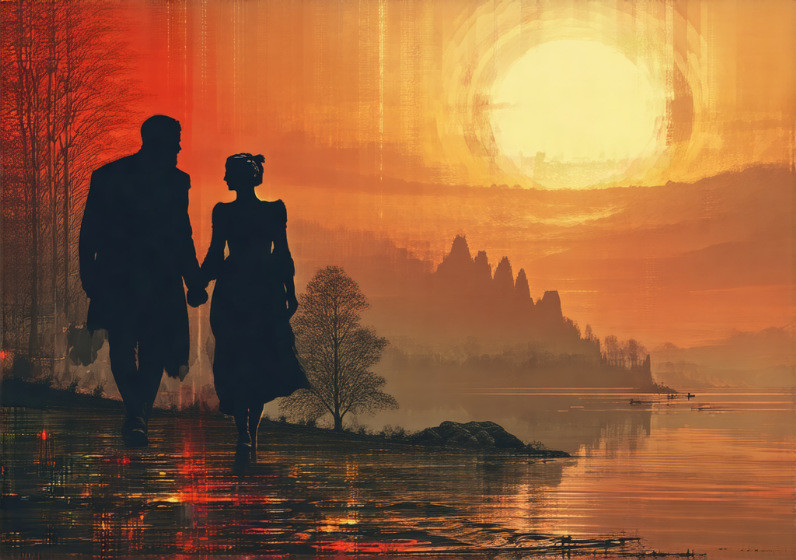
Gothic Exile: Darker Narratives of Love Forged in Separation
☾ Gothic Exile ☽
Darker Narratives of Love Forged in Separation
By Mirella Voss, Ph.D.
There is a particular quality to the silence that follows departure. It does not arrive like sound; it settles, rather, like dust on an open book or frost upon glass. In our small town, where the church bells mark time with mechanical precision and the streets are mapped out in familiar, predictable arcs, departure is rare enough to feel almost heretical. When someone leaves—when a lover walks out of the doorway that once held them both, or when distance stretches the thread between two hearts until it snaps—the quiet that remains becomes its own kind of monument. It is here, in this hollowed-out space, that I find myself returning again and again: to the philosophy of absence, to the strange alchemy by which loss can become a form of love more complete than presence ever was.
We are taught to think of love as a union—two bodies merging, two wills aligning, two timelines braided into one. And in our local parlance, in the way we speak at supper tables and church socials, love is something you have, something that sits beside you on the bench or sleeps across from you under the same quilt. But philosophers have long known this to be an incomplete picture. To love someone who is not there—someone whom you can no longer touch, no longer argue with over whose turn it is to wash the dishes, no longer see fidgeting under a tablecloth in the café on Main Street—is to engage with one of the most difficult questions in human experience: Can a bond survive without the body that gives it form?
The ancients would have said yes, and they would have said it with more confidence than we dare. For Plato, true love was not the affection between two flesh-bound creatures but an ascent toward Form—the eternal, unchanging idea of Beauty or Goodness that our imperfect bodies merely gesture toward. When your beloved leaves for a city three hundred miles away, what remains is not a lesser version of love; it is a purer one, stripped of the small frictions and daily negotiations that so often obscure the essential bond. The exile who loves from afar is, in a sense, closer to Platonic purity than the couple bickering over rent money. There is something almost sacred about this—something that our local idiom, for all its warmth, rarely articulates.
And yet I do not want to romanticize absence so completely that it becomes an escape from the very real pain of separation. Because it hurts. God help us, it hurts in a way that philosophy can describe but never fully explain—the body keeps insisting on presence even when the mind has accepted absence. The coffee cup left unwashed. The side of the bed that stays cool. The particular way a song on the radio triggers not joy but a slow, aching recognition that someone who used to hum along is no longer in the room. This is what I think of as the gothic register of love: it does not deny the darkness; it inhabits it. It lets the shadow speak.
There is a tradition in literature and philosophy—stretching from Kierkegaard's Either/Or to Dostoevsky's labyrinthine psychodramas—that treats exile as a condition that clarifies rather than diminishes. The exiled lover, cut off from the daily rituals of partnership, is forced into an almost ascetic confrontation with desire. Without the comfort of physical presence, love becomes pure intention, pure will, pure choosing to hold someone in mind when nothing external compels or rewards that act. It is a form of devotion that requires no audience, no witness, no social confirmation. In our town, where everyone knows everyone's business and relationships are semi-public performances, this kind of private, unperformed love might feel radical—almost subversive.
Consider the local examples that come to mind without effort. There is Mrs. Alderman on Elm Street, whose husband was stationed overseas for two years during a military posting. She spoke once at our library book club about how she had begun keeping his reading glasses on her nightstand, adjusting them each morning as if he might return before dinner. The ritual had no practical purpose—she could not use his glasses; they did not fit her eyes. But the act of handling that small, glass-and-metal object was a way of saying: You are still here. I have not let go. This is love in its most elemental form—not emotion, exactly, but attention. The decision to keep looking for someone who may not be looking back.
Or consider Thomas and Lena, the young couple at the hardware store on Route 9, where Lena took a teaching position in a neighboring county. They video-call every Sunday evening, and I have seen them through the shop window, both leaning forward into their phones with an intensity that seems almost liturgical. Their town is not theirs anymore, exactly; they are each in exile from the other's daily world. But something in the way they speak—slower than usual, more deliberate, as if each word must be chosen with care because it will travel through a screen and arrive slightly diminished—suggests that the distance has refined their language of affection into something more precise than proximity allows. They are not performing for an audience. They are speaking to one soul only, across a void that technology fills but does not close.
There is a risk in all this, though—a danger I want to name honestly. The gothic register of love can become self-indulgent. We can mistake the aesthetic quality of longing—its beauty, its poetry—for love itself. A woman who keeps her ex's jacket on the hook for three years may be honoring a genuine bond, or she may be curating a private monument to a feeling that no longer corresponds to any living person. Philosophy asks us to distinguish between loving and mourning, and in our local context, where social expectations often blur the two (you should still grieve your partner's departure as if it were a death; you should be seen at his mother's kitchen table on Sundays), this distinction is harder to maintain.
I think what saves us—what keeps gothic exile from collapsing into pure melancholia—is community. This is where our small-town context becomes philosophically significant in a way that might not be immediately obvious. In a place where everyone shares the same schools, churches, and grocery stores, absence is never fully private. The neighbors notice. Mrs. Alderman's empty house gets noticed; people bring casseroles, check on her garden, ask about the glasses she keeps polishing. Thomas and Lena's Sunday video calls are known; the hardware store employees nod when Lena mentions it, a small communal acknowledgment that this young woman is carrying something heavy and beautiful simultaneously. We do not have the luxury of total privacy in our grief or our longing, but perhaps that is as it should be. Love in exile, left entirely to the individual, can curdle into self-pity; love in exile, witnessed by a community that neither judges nor intrudes, retains its dignity and its truth.
There is also a question of time that I find particularly relevant here. In our town, time is marked externally—by seasons, by holidays, by the particular quality of light on the maple trees in October or the first crocuses pushing through frost in March. For the exiled lover, though, subjective time can decouple from calendar time. A year without your partner does not feel like a year; it feels like an interminable evening that will never become morning. Or conversely, two weeks apart can feel like a lifetime if the separation is sudden and unprepared for. Philosophy calls this the phenomenology of duration—the way consciousness stretches or compresses time according to its emotional state. And in our local idiom, I think we simply call it "hard." We say the first winter was hard; we say that summer felt long. We do not reach for Heidegger or Bergson. But the experience is exactly what they described: time as lived, not measured.
I want to end with a thought about return, because in our town, people come back. The military posting ends. The teaching contract expires. The friend who moved across state lines runs into you at a family reunion and your hands shake over the coffee cup and it is real again—the body, the breath, the particular way someone tilts their head when they're thinking. And here is what I have come to believe: return does not erase exile; it completes it. The two states are not opposites but partners in a dialectic. You cannot fully understand what presence means until you have known absence, and you cannot know what your love truly costs or truly means until it has been tested by distance. The gothic narrative of love is not one of tragic loss; it is one of refinement. Separation strips away the incidental, the habitual, the merely social performance of affection, and what remains is either nothing—or something rare and sturdy enough to survive the void.
In our town, we are a people of returners. We come home for weddings, funerals, Fourth of July cookouts, the occasional argument about whose turn it is to mow the neighbor's lawn. And when we come back, carrying the particular silence that only exile teaches you how to hold, I think something shifts in our small-town fabric. The gothic light—that deep, shadowed quality of a love forged in absence—becomes visible in the way we look at each other across kitchen tables and church pews. We see more. We say less, but what we say is chosen with a care that proximity alone could never produce.
This is not a philosophy for the faint-hearted. It asks us to sit with the cold side of the bed. It asks us to keep polishing glasses that don't fit our eyes. It asks us to speak through screens and let each word carry more weight than we are used to carrying. But it gives us something in return: a love that has been tested by distance and found wanting nothing—found, in fact, more than proximity could have provided. And in a town where everyone already knows your business, where the church bell marks every hour and the maple trees mark every season, this private, gothic register of devotion becomes its own quiet form of freedom.
☾ Mirella Voss writes on philosophy, literature, and the strange beauty of small-town life.