Falling In Love Is A Biological Trap: How To Stay Safe
The Alchemical Heart: Escaping the Chemical Illusion of Romance 💫
We are often taught that falling in love is a journey toward enlightenment, a spiritual union of souls. But if we strip away the poetry and examine the physiology of romance through a philosophical lens, the picture becomes far more nuanced—and significantly more dangerous to your individuality. Falling in love is not merely an emotion; it is a biological trap. It is a neurochemical storm designed by evolution to ensure reproduction, not necessarily personal growth or lasting harmony. To stay safe in this trap—to preserve your mind, your agency, and your true self—you must understand the alchemy of attraction and learn to transmute raw passion into stable, conscious love.
Let us begin with the biology, for it is here that the illusion is built. When you fall in love, your brain does not feel "romantic." It feels like it is on drugs. Neuroscientists have scanned the brains of people who are newly in love and found activity patterns strikingly similar to those of individuals addicted to cocaine or amphetamines. The prefrontal cortex—the seat of logic, judgment, and long-term planning—literally dims in activity. Meanwhile, the reward centers light up like a firework display. Dopamine surges, creating an intense sense of craving and pleasure. Norepinephrine spikes, keeping you awake, anxious, and hyper-focused on your partner. Oxytocin and vasopressin flood the system, fostering attachment and trust.
This cocktail is not designed to give you a clear view of your partner or yourself. It is designed to blind you. The philosopher Blaise Pascal observed that "the heart has its reasons which reason does not know." In romance, this is literal. Your biological imperative overrides your rational faculties. You see your partner through a lens of idealization; their flaws are minimized, their virtues magnified. This is the trap: you are not in love with who they actually are, but with a neurological projection of them. And because your critical thinking is chemically suppressed, it is difficult to recognize this distortion while it happens.
So how do we stay safe? How do we navigate a state where our own brains work against us? The answer lies in philosophical mindfulness and the ancient art of alchemy. Alchemy, the precursor to modern chemistry, was not just about turning base metal into gold; it was a process of purification and transformation. We must apply this same principle to our emotional landscape.
First, practice dis-idealization. This is the intellectual discipline of actively seeking out the human reality behind the romantic image. When you feel that overwhelming rush of "this person is my soulmate," engage your prefrontal cortex deliberately. Ask questions: What are their habits when they are tired? How do they handle disagreement? Do their values align with mine, or am I simply enjoying the dopamine hit of novelty? This does not mean you stop caring or stop feeling; it means you add a layer of observational clarity on top of the chemical noise. You are learning to see through the smoke.
Second, protect your autonomy. One of the great philosophical dangers in romance is the loss of self—the merging into a "we" so complete that individual identities dissolve. This is often romanticized as unity, but it can be a form of subtle annihilation. To stay safe, you must maintain an internal life that exists independent of your partner. Keep your hobbies, your friendships, your quiet time, and your private thoughts. Your worth is not derived from being chosen; it derives from your own completeness. A healthy relationship is between two whole circles that overlap, not two half-circles trying to make a complete one. When you remain autonomous, you are less likely to be swept up by the biological trap, because you have an anchor in your own identity.
Third, distinguish between attraction and love. Biologically, attraction is intense, urgent, and often temporary—its primary purpose is pairing for reproduction or bonding. Philosophically and psychologically, love (in its mature form) is more stable, broader, and rooted in mutual respect and shared values. Attraction says "I want you." Love says "I understand you and we are growing together." If your relationship feels like a constant fever of excitement and anxiety, it may be that you are still in the biological phase. True safety comes when the fireworks fade, and you choose each other with clear eyes. This is the transmutation: turning the volatile flame of passion into the steady light of devotion.
Fourth, embrace vulnerability without surrender. To love is to open yourself up, which means making yourself susceptible to pain. The philosopher Kierkegaard spoke of anxiety as "the dizziness of freedom." In love, this dizziness becomes the dizziness of attachment. We fear rejection, we fear being seen, we fear loss. Staying safe does not mean building walls; it means building boundaries. Know what you are willing to give and where your limits lie. Understand that vulnerability is a choice, not a compulsion. You open the door because you want to invite someone in, not because you are afraid of being alone or biologically compelled to pair-bond.
Finally, consider the role of time. The biological trap works best in the short term—the first few months of intense courtship. Over time, neurochemical levels stabilize, and the initial blinding rush subsides. This is often mistaken for "falling out of love," but it is actually a maturation process. The alchemist knows that not all change is decay; sometimes, change is refinement. Give yourself time to see the relationship through different seasons—calm and storm, joy and sorrow. How do you treat each other when there are no grand gestures or neurochemical highs? That is where the true nature of the bond reveals itself.
In essence, staying safe in love means becoming the observer of your own experience. You allow yourself to feel, but you also study what you feel. You let the biology do its work, but you do not be governed by it entirely. This is a philosophical stance: not passive surrender, but active participation in your own emotional life.
There is something profoundly human—and beautifully ancient—about this struggle. We are creatures of impulse who strive for wisdom. We are bodies that crave closeness while our minds demand clarity. The art of love, then, is an ongoing negotiation between these two poles. It is not about suppressing the biological trap; it is about understanding its mechanics so you can navigate it with grace and intention.
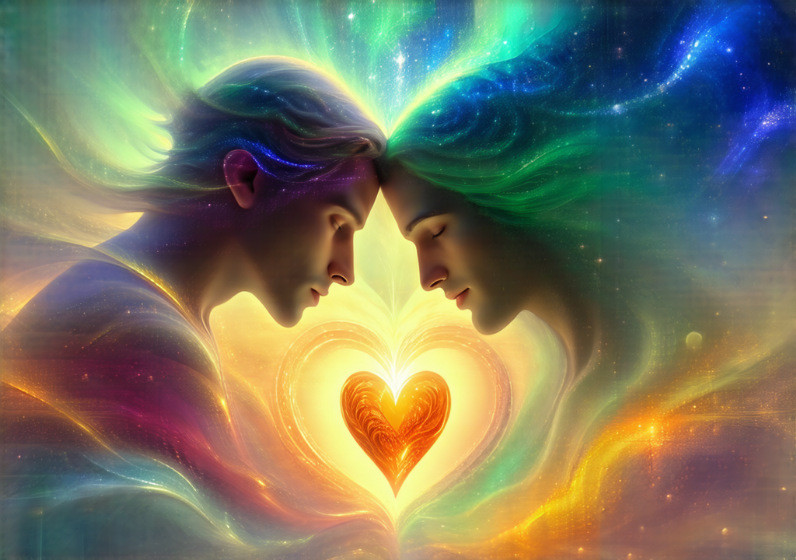
Imagine your heart as a crucible in an alchemist's workshop. The raw ores of attraction—passion, desire, infatuation—are placed inside. Heat is applied through experience, time, and reflection. Impurities burn away: the idealizations, the anxieties, the blind spots. What remains is not the glittering but fragile gold of fantasy, but a sturdier, more honest alloy—a relationship built on mutual recognition, respect, and chosen commitment.
So when you find yourself in that intoxicating, blinding rush of new love, do not fight it. Let it warm you. But also step back, light a candle by the window, and look at your reflection in the glass. Ask yourself: Who am I beneath this feeling? Am I seeing clearly? Am I preserving my own mind while opening my heart?
This is how we stay safe. Not by avoiding love, but by engaging with it consciously—transmuting the biological trap into a space of genuine, enduring connection. And in that alchemical process, something remarkable happens: the base metal of mere impulse becomes the gold of true understanding.