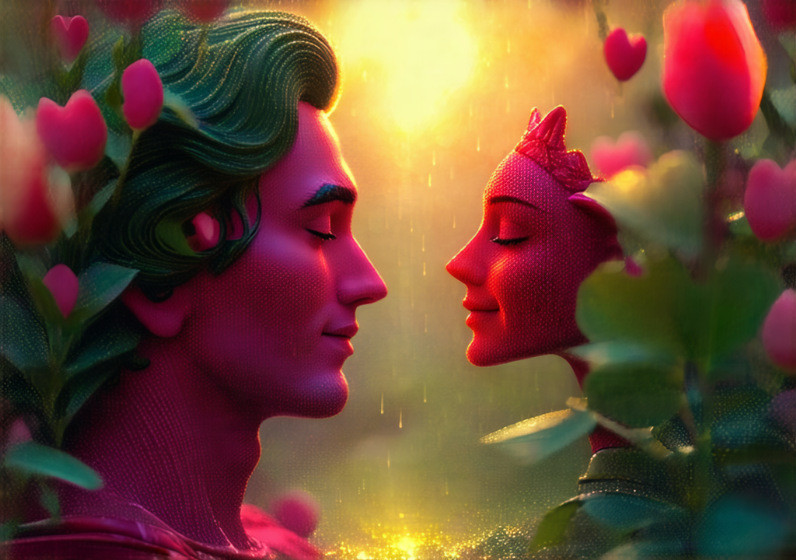
Epic Spring: Heroic Narratives Where Innocence Becomes Devotion
⭐️ The Sacred Fall of Loving You 🕯️
By Aurelia Nightshade, Ph.D. in Philosophy
We are taught that falling in love is a joyful accident—a lucky stumble into the arms of fate. A slip from the ledge of solitude into the soft grass of togetherness. But if we look at the architecture of romance through the lens of philosophy, and particularly the great myths that have shaped our understanding of devotion, the metaphor of "falling" takes on a darker, more profound weight. It becomes less about an accident and more about an initiation. In the epic narratives of our cultural memory, love is not merely a feeling; it is a descent into a sacred underworld where innocence is stripped away, burned in the fire of desire, and reborn as pure, unshakeable devotion.
To understand this transformation, we must first examine what "innocence" actually means in these heroic narratives. Innocence is often mistaken for purity or naivety, but philosophically, it is a state of potentiality. It is the blank slate before the ink of experience has been applied. In mythological and literary epics—think of Orpheus and Eurydice, Tristan and Iseult, or even the early chapters of The Divine Comedy—the lover begins in a state of relative isolation. They are whole unto themselves, self-contained, and often somewhat limited by their own individuality. This is the innocence: a pristine, but incomplete, existence. It is the sunlit world above ground, bright and safe, but lacking the depth that comes from shadow.
Then comes the fall. And here we must be precise with our metaphor. The Epic of Spring, as it were, is not about the gentle blossoming of flowers in April; it is about the volcanic eruption of emotion that breaks through the frozen crust of the self. The "fall" in love is a gravitational pull so strong it overcomes all rational resistance. It is an ontological shift. When you fall in love, your center of gravity moves from yourself to another person. This is a terrifying experience for the ego, which has spent years constructing walls and boundaries to protect its autonomy. Love tears down those walls. The innocence that once kept us safe in our little world becomes the very thing that makes us vulnerable. We become open, exposed, and radically dependent on forces beyond our control.
Consider the archetypal narrative of the hero’s journey as it applies to romance. Joseph Campbell spoke of the "descent into the belly of the whale"—a symbolic death before rebirth. In love, this descent is the moment you let go of your illusion of self-sufficiency. You admit that you are not enough on your own. You acknowledge a hunger that only another soul can feed. This admission of need is the antithesis of the stoic, heroic ideal we often celebrate in action films or grand historical epics. Here, heroism is not about conquering an enemy; it is about surrendering to a mystery. It is an act of philosophical humility. The innocent lover says: "I do not know how this will go, but I am willing to risk everything for the chance that it might be beautiful."
As we trace the arc of these epic narratives, we see that the transition from innocence to devotion is rarely smooth. It is often marked by trial, temptation, and sometimes even betrayal. But it is precisely through these trials that love is refined. Alchemists speak of nigredo—the blackening process where matter is broken down before it can be transformed into gold. In the narrative of falling in love, this is the period of doubt, jealousy, insecurity, and fear. The innocent lover looks at their partner and sees not just a source of joy but also a potential threat to their happiness. They begin to navigate the complex terrain of another person’s mind, emotions, and history. This is where the true work begins.
Devotion, in this philosophical sense, is not a passive state. It is an active, continuous choice. While innocence is given to us at birth (or at least, we start with it), devotion must be built day by day, moment by moment. It is the decision to remain present even when passion fades into routine. It is the commitment to see your partner not just through the rose-tinted glasses of early infatuation, but in their full, unvarnished humanity—flaws and all—and to love them for it. This is a heroic act because it requires us to go against our own self-interest at times. We make sacrifices. We listen when we’d rather speak. We forgive when we feel wronged. We choose the other person over our own comfort, pride, or convenience.
There is a beautiful paradox in this process: by losing our innocence (our naive idealism), we gain something far more valuable—authenticity. The innocent lover loves an image, a projection, a fantasy constructed by their own desires. The devoted lover loves the actual person, with all their contradictions and complexities. This is where the epic quality of love reveals itself. It becomes a grand narrative not because it involves dragons or kings, but because it involves the fundamental question of human existence: How do we transcend our individuality? How do we find meaning in connection?
In the local context, this may sound abstract, but look around you. Watch the couple at the corner café who have been together for thirty years. They are no longer in the "innocent" phase; their hearts are not racing when they see each other anymore. But watch how they interact. The small gestures—the passing of a sugar packet, the adjustment of a chair, the quiet nod of understanding—these are the artifacts of devotion. Their love story is an epic written in the language of daily life. It is less dramatic than a mythic battle scene, but perhaps more heroic because it requires consistency rather than a single grand gesture.
We live in a culture that often romanticizes the "fall" itself—the spark, the first kiss, the dizzying excitement. And there is no denying its beauty. But for those of us who have walked further down this path, we know that the real treasure lies beyond the fall. It lies in the landscape that reveals itself once you hit the ground and stand up again. This is where devotion takes root. It is quiet, sturdy, and enduring like an old oak tree that has weathered many seasons.
From a philosophical standpoint, this transformation addresses one of our deepest existential needs: the need for recognition. We are not just biological organisms; we are beings who seek to be seen, known, and valued by another consciousness. Innocence is a state where we are largely unknown to others because we have not yet fully opened ourselves. Devotion is the state where we have been truly seen—our fears, our dreams, our petty habits, our grand ambitions—and we have chosen to stay in that visibility with someone who sees us clearly and loves us anyway.
This is a sacred exchange. It is a mutual gift of vulnerability. And like all sacred things, it requires care, reverence, and intention. You cannot take devotion for granted. It must be tended like a garden in spring—watered, weeded, and protected from the elements. The "Epic Spring" of love is not just a season; it is a perpetual state of becoming. Every day offers a new opportunity to deepen that devotion. Every small act of kindness reinforces the bond. Every moment of patience builds the foundation for greater understanding.
So, let us redefine our view of falling in love. Let us see it not as a loss of control or a silly accident, but as an epic journey of self-discovery through another. It is a philosophical quest where the hero’s weapon is not a sword, but the heart. Where the battlefield is not a field of battle, but the intimate space between two souls. And where the ultimate victory is not conquest, but communion.
In our online article, we often celebrate community, family, and shared experiences. Love is perhaps the most fundamental form of these. It is the thread that binds us to each other in a world that can feel increasingly fragmented and isolated. When you love someone with devotion, you are asserting that they matter. That their life has meaning because they are woven into yours, and yours into theirs. This is a powerful statement in an age of transience and digital disconnection. It says: "You are real to me. You are important to me. And I am here."
As we navigate our own personal narratives, let us honor the innocence that started it all—that first spark of curiosity and hope—but also celebrate the devotion that has sustained us since. Let us recognize that every relationship is an epic in its own right, written by the two people within it. It may not be published or celebrated on a grand stage, but to those who know it best, it is as magnificent as any ancient myth.
So here’s to all of you reading this—those who are just beginning their fall and those who have been walking in devotion for decades. May your springs be ever-blooming. May your falls be soft landings. And may your devotion deepen with every passing season, turning the simple act of loving someone into a masterpiece of human connection.
In the end, to love is to choose again and again, in the face of all evidence that it might not work out, to believe that this one person, in this one moment, makes life worth living. That is heroism. That is devotion. And that is the true epic of spring.