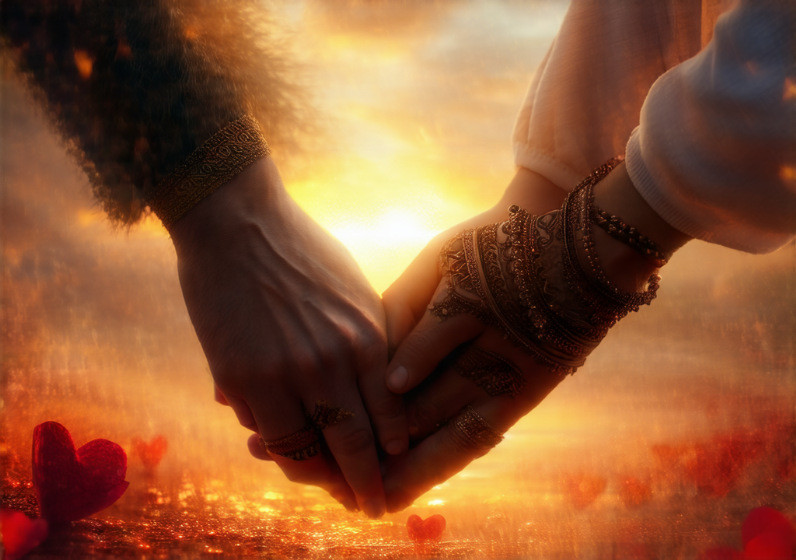
Derrida and the Trace of Pain: How Wound Becomes Window to Intimacy
✍️ The Ontology of Bruising: Why We Crave What Hurts
By Madame Éloise Vonn, M.A.
✦
We have been taught that love is a gentle thing. In the fairy tales and the romantic comedies, it arrives like a warm blanket, a sudden clarity, a song that makes the dust motes dance in sunbeams. We expect the beloved to be a mirror that flatters us, or at least one that reflects our own self-image without distortion. But love is not a gentle thing. It is an act of violence so intimate it feels like grace. To fall in love is to invite another person into the cathedral of your private mind and allow them to rearrange the furniture with heavy hands. It is to offer up your skin, knowing that they may scratch it. It is to build a house out of glass and stand beneath the sun until you are warm enough to shatter.
We speak of "falling" in love, and we should pay attention to the verb. Falling implies gravity, loss of control, a descent from some higher plateau of rational self-possession into the red earth below. When we fall, we do not choose where we land. We are flung by an invisible force—chemistry, proximity, a shared silence that feels louder than speech—and we crash into another human being with all the momentum of our unsatisfied histories. The impact is the first true act of love: the bruise forming under the skin, the shock in the nervous system, the sudden awareness that we are not alone in this cold universe. And it is there, in that wound, that intimacy begins to bloom.
Consider the nature of a wound. A wound is a break in the continuous surface of the self. Before you were wounded, your skin was a boundary—a membrane between the interior world of your thoughts and feelings and the exterior world of other people’s expectations and judgments. You were sealed. You were safe. And you were lonely. To be wounded by love is to have that seal broken. The blood flows out—your vulnerabilities, your fears, your embarrassing smallness—and the world rushes in with its own blood: their history, their contradictions, their particular way of laughing at a joke only you two understand. Intimacy is not the absence of distance; it is the negotiation across a gap that has been made visible and vulnerable by pain.
Derrida spoke of the trace—that mark left behind after something has passed through. A trace is both presence and absence, a sign that points to what is no longer there but continues to act upon us. Every relationship carries traces: the words said in anger that we can never take back; the touch that lingered too long or not long enough; the promise made at 3 a.m. over wine that dissolves by morning like sugar in coffee. We are haunted by these traces, and it is precisely this haunting that binds us to one another more tightly than any pleasant memory could. A happy memory fades. A painful one calcifies into identity. You become partly defined by the way you were hurt, and by the way you chose—consciously or not—to stay despite it.
There is a philosophy in the simple act of choosing to remain with someone who has wounded you. It is not masochism, though society often conflates the two. Masochism seeks pain for its own sake; loving through pain means that the pain becomes a language, a shared cipher. When your partner says "I need space," and you feel the old wound from your father’s silence reopen in your chest, you are not just interpreting their words—you are reading the trace of your own history in their present action. You are having a conversation across time, between the person who hurt you then and the person who is sitting across the table now. This layering of past and present, self and other, is what makes love so terrifying and so necessary.
We romanticize vulnerability, but we rarely prepare for it. We build our self-concepts like fortresses—thick walls, moats, drawbridges—and then one person finds a door we forgot to lock and walks in with a smile that says I know your secrets now. The fortress becomes a home only when you lower the drawbridge. And lowering the drawbridge means accepting that this stranger might also be a thief, or at least someone who will move things around in your house without asking. You will find your books on different shelves. Your coffee will be left in a different spot. Small displacements, but they add up to a new geography of shared life.
Here is the paradox: we want to be seen, and being seen by love always involves a small death. The self you were before this person knew you—polished, curated, manageable—is gone. What remains is something messier, more three-dimensional, occasionally embarrassing. You will burp loudly in front of them. You will have the same argument for six years. You will wake up at 4 a.m. wondering if they are still awake or if they left quietly while you slept. These small uncertainties are the texture of real intimacy. The fairy-tale version of love is a single, perfect frame; real love is an endless film where some frames are blurry, some are overexposed, and one or two come out perfectly clear in a way that makes your chest ache with gratitude.
And what about the pain itself? Why do we cling to it so often? Perhaps because pain is more honest than pleasure. Pleasure can be a performance; pain is difficult to fake. When someone cries in front of you, when they admit their jealousy or their fear or their small resentment over a dish left in the sink for three days, they are giving you the raw material of who they actually are—unfiltered, unedited, not performing the role of "perfect partner." You receive this gift and hold it in your hands like something fragile and valuable. The pain is not the point; the honesty inside the pain is the point.
There is a particular beauty in two people discovering that their wounds align. Not perfectly—no two wounds are identical—but closely enough to fit together, like puzzle pieces from different boxes that were clearly made for one another. Your need for quiet resonates with their need for solitude. Their fear of abandonment mirrors your own, and you recognize it because you feel the same cold dread in your own stomach. This recognition is a form of love deeper than affection: it is kinship. You have found someone who speaks your body’s language without needing to translate it into words.
The philosopher Kierkegaard wrote that "life can only be understood backwards, but it must be lived forwards." Love works the same way. You do not know you are falling in love until you are already on the ground, bruised and blinking, looking up at the person who was there when you landed. And by then, the wound has started to close. The edges soften. The red fades to yellow, then to that pale silver that is neither quite scar nor unmarked skin but something new: a place where your old self ends and your shared self begins.
So here is my advice, offered with the modesty of someone who has been wronged by love more times than I can count: do not wait for it to be painless. Do not try to engineer a version of intimacy that never hurts. The pain is not evidence that something has gone wrong; it is evidence that you are in contact with another real, finite, complicated human being who will one day die and take their particular way of looking at you into the quiet dark. Grieve for that future absence now, gently, as a kind of pre-grief. Let the pain be your window. Look through it not to complain about the weather on the other side but because that is how light gets in. That is how the world becomes sharp and beautiful and unbearable and exactly what you have been trying to find all along: someone who sees the bruise and calls it "lovely."
✦