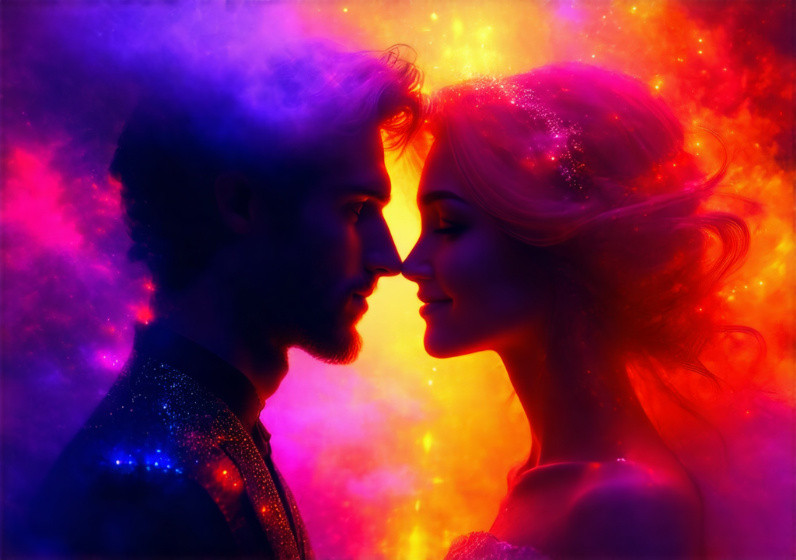
Cultural Scripts for Love: How Society Teaches Us to Feel Instantly
The Alchemy of Attraction: Decoding the Social Rituals of the First Spark ✨
In the grand theatre of human emotion, few performances are as universally rehearsed yet as personally felt as falling in love. For centuries, poets have claimed that romance is a sudden lightning strike—an inexplicable jolt of electricity that renders logic obsolete and binds two souls in an instant union. Yet, as we peel back the romanticized veil, a more complex truth emerges: that our capacity to feel "instantly" is not a mystery, but a sophisticated product of cultural scripting. Society does not merely witness our romances; it actively directs them, providing the stage lights, the script, and even the chemical cues that teach us how to recognize a partner before we have spoken a single word.
To understand this phenomenon, one must look beyond the individual heart and examine the collective mind. We do not fall in love in a vacuum; we fall into it. The "spark" is less of an electrical event and more of a cultural signal, a confirmation that two individuals are following the same social algorithm for desirability. This article explores how modern culture has codified the experience of attraction, transforming a biological impulse into a shared language where familiarity itself becomes the primary ingredient in the recipe for instant affection.
The first script we inherit is the narrative of "Soulmates." This cultural myth suggests that somewhere out there exists one person perfectly calibrated to our unique frequency. It implies that love is not built but found, like a lost coin on the sidewalk or a key fitting an old lock. This belief sets an incredibly high threshold for the first impression. We are taught to look for a mirror of our own inner world in another’s face. When we find someone who seems to understand us before we have even explained ourselves, it feels magical. In reality, however, this is often just pattern matching. We are drawn to those whose gestures, speech patterns, and values echo our own cultural training. We recognize the script because we wrote it; or rather, society wrote it for us long ago. The "instant" connection is merely the recognition of a familiar dialect in an unfamiliar tongue.
Furthermore, the visual architecture of modern romance has been heavily influenced by media. Film and television have provided us with a lexicon of romantic aesthetics that our subconscious minds use as a checklist. We are conditioned to look for specific traits: the charming smile, the casual lean-in, the eye contact that lingers just a beat too long. These are not universal constants; they are stylistic choices popularized by Hollywood and reinforced by social media. When we meet someone who mimics these cinematic cues, our brains process them as "romantic" because we have seen them paired with love scenes thousands of times. We are essentially pattern-matching against a cultural database of romance. If a stranger at a coffee shop makes eye contact for three seconds and smiles softly, it triggers the same neural pathways as if they had just recited a sonnet, simply because that is how our culture has taught us to "read" interest.
The role of language in constructing instant affection cannot be overstated. We have an entire vocabulary dedicated to the micro-expressions of liking: "flirting," "vibing," "clicking." These words act as social shorthand, allowing us to categorize and accelerate emotional bonding. When two people say they "clicked" instantly, they are essentially saying that their cultural scripts aligned perfectly at the point of contact. This alignment reduces cognitive dissonance. In a world full of uncertainty, finding someone who speaks the same romantic language provides an immediate sense of safety and validation. It is a social contract signed in glances and tone of voice before any formal agreement is made.
There is also the phenomenon of "familiarity bias," which plays a crucial role in these rapid connections. Psychologists have long noted that we tend to be attracted to those who are similar to us. In a highly homogenized cultural landscape, "similarity" often means sharing the same media consumption habits, the same social circles, and the same value systems. We live in echo chambers of taste; we listen to the same playlists, watch the same shows, and follow the same influencers. When we meet someone who shares these cultural artifacts, it creates a bridge of intimacy that feels deeper than it is. It feels like an instant bond because the foundation was already built by our shared environment. We are not connecting with a stranger; we are connecting with a colleague in the industry of being "us."
However, this cultural scripting carries a subtle philosophical weight. If society teaches us how to feel instantly, does that diminish the authenticity of the emotion? Or does it enhance it by providing a framework for expression? One could argue that all emotions are culturally mediated. We do not feel "happiness" in a raw state; we feel it through cultural lenses that tell us what happiness looks like and sounds like. Similarly, love is interpreted through our social context. A medieval peasant’s instant spark was likely based on proximity and economic compatibility, while a modern urbanite’s is based on shared aesthetic tastes and digital presence. The feeling may be biological, but the interpretation is cultural.
This brings us to the question of agency. Are we free lovers, or are we puppets dancing to the rhythm of popular culture? Perhaps it is both. Our bodies react with chemistry and adrenaline, but our minds interpret those reactions through the scripts provided by our society. We learn to love because we have been shown how to do it. We fall in love instantly because we have been taught what "instant" looks like. This does not make love fake; it makes it collaborative. It is a joint performance between individual desire and collective expectation.
As we move further into an era of algorithmic curation, where apps and platforms suggest partners based on data points, the cultural script becomes even more explicit. We are now falling in love with probability algorithms disguised as destiny. The "instant" feeling is increasingly the result of a curated environment designed to maximize compatibility metrics. This digital layer adds another dimension to the cultural teaching: we are learning to feel attraction through screens, anticipating connection before physical presence is confirmed.
In conclusion, falling in love instantly is not a mystery of the soul, but a mastery of social cues. It is the result of a lifetime of watching, reading, and participating in the cultural performance of romance. We are all students in an academy of affection, where the curriculum is written by poets, directors, and sociologists alike. To understand our own romantic experiences, we must look at the script in our hands. By recognizing that our "instincts" are largely inherited, we can approach love with greater self-awareness. We can distinguish between a genuine resonance and a culturally induced reflex. And perhaps, in doing so, we can find a form of connection that is not just scripted, but truly seen—where the spark is real because it was chosen by minds aware of the stage they are sharing.
In this modern age, let us celebrate the alchemy of attraction ✨. It is a beautiful dance of biology and culture, where two people recognize each other in the mirror of society. We are not just falling; we are being lifted by the collective hand of our shared story. And that, perhaps, is the most romantic truth of all: that our feelings are woven from the fabric of everyone else’s experience, making every instant connection a testament to our profound, invisible kinship.