Aha! The Moment of Recognition: Why We Fall for Strangers
✨ The Electric Hum of Recognition
By Seren Blackwood, M.Phil.
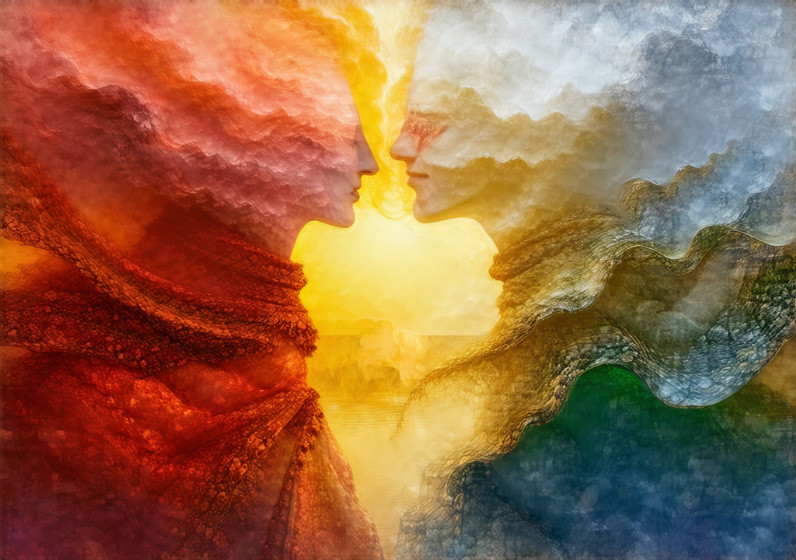
There is a peculiar cruelty in human longing. We spend our days walking through crowds of strangers, our eyes scanning faces that are essentially invisible to us—people with their own inner monologues, their own ghosts, their own quiet wars being fought behind the glass of their retinas. And then, suddenly, one face stops the noise. The world narrows. A stranger becomes a protagonist. We do not merely see them; we recognize them. This is the paradox at the heart of falling in love: it feels like a discovery, yet the person was an absolute unknown before you looked up.
As a philosopher, I have spent years dissecting the architecture of human connection, and nowhere is the machinery more elegant or more fragile than in that first flicker of recognition. It is not simply chemistry; it is an ontological event. In a sense, to fall for someone is to rewrite reality. Before you met them, they were not part of your narrative. After you meet them, your past changes. The years before the meeting are re-lit by their presence. You begin to see traces of them in old photographs; you hear their laugh in songs you’ve listened to a hundred times. Time itself becomes non-linear, bending toward that singular point of intersection.
Why do we fall for strangers? It is not because they possess some magical, self-contained perfection. We do not love people as objects are loved—defined by fixed properties like weight or color. We love them as events. A lover is a happening. They are the way light refracts through a specific prism on a specific afternoon. If you remove one factor—the angle of the sun, the moisture in the air, the particular state of your own heart—the refraction changes entirely. To fall for someone is to participate in a unique configuration that will never happen again with the same precision. We are falling not for a person, but for the moment they make possible.
Consider the role of mystery. If we already knew everything about another person—every preference, every fear, every hidden shame—we would find it difficult to fall in love with them. Knowledge is often the solvent that dissolves romance. We need the stranger. We need the gap between what we perceive and what actually exists. That gap is where imagination lives, and imagination is the true engine of desire. When you meet a stranger, your mind instantly begins to draft biographies for them. You assign them a childhood you have never seen; you invent a favorite song they will likely never sing. You build a cathedral in the mind before you’ve even walked through the front door. The lover is not the person; the lover is the story we are willing to believe about them.
This brings us to an ancient and uncomfortable question: do we love the other, or do we love the self reflected in the other? There is a philosophical tradition that argues we seek in others only what we lack within ourselves. We fall for the intellectual because we feel dull; we fall for the quiet one because our own inner voice is too loud. The stranger becomes a mirror, and we are so eager to see a better version of ourselves that we mistake their face for our own soulmate. This is not entirely cynical; it is merely honest. Love is an act of projection as much as reception. We pour our narrative needs into the empty vessel of a stranger and call it intimacy.
Yet there is more. Recognition implies a meeting of two separate worlds. In philosophy, we speak of intentionality—the mind’s directedness toward objects. When you fall in love, your intentionality shifts. Your attention becomes a laser beam locked onto one person among millions. You begin to notice how they hold their coffee cup, the way their eyelashes cast shadows in low light, the particular cadence of their silence. These details are not just aesthetic; they are data points in an ongoing act of translation. You are learning a new language, and the grammar is entirely idiosyncratic. The stranger ceases to be generic humanity and becomes this person—irreplaceable, unrepeatable, a singular node in the vast network of existence.
There is also a spiritual dimension that rarely makes it into popular psychology but belongs at the center of the experience. To recognize someone as worthy of love is to grant them dignity. It is an act of reverence. In a world that often reduces people to functions—consumers, workers, demographics—to see someone fully and choose them is almost sacred. You have looked past their utility and found a soul. This is why falling in love feels like being blessed. It is not just emotion; it is recognition of value where society sees only function.
Of course, this recognition is fragile. The moment you stop imagining the cathedral, the person becomes concrete again. They make mistakes. They have bad breath. They say things that don’t match the biographies you wrote for them. And then you are left with a choice: continue to love the story, or learn to love the stranger? Mature love is when you set down your script and actually listen. It is when recognition transcends projection and becomes genuine attention. You stop falling in love with what they could be and start noticing who they are.
This is why the initial spark can feel so electric—it is the collision of two mysteries. No one has ever truly known another person, not even after fifty years together. We carry our own secret rooms, our own quiet doubts that we never share. And perhaps that is as it should be. If you knew me completely, if you could read every thought and memory, I would become a text—a thing to be analyzed rather than a being to be loved. The stranger remains a stranger even in intimacy, and that residual mystery is the oxygen love breathes.
So when you find yourself falling for someone—when your chest tightens and time slows and their name feels like a secret only you are allowed to know—do not mistake it for simple attraction. You are participating in one of the most profound acts available to human beings: recognizing another consciousness as real, as valuable, as worthy of your finite attention. It is rare that two strangers stand on opposite sides of an abyss and choose to build a bridge. And in that choosing, you do not just find someone else; you find yourself seen for the first time by eyes that have no reason to be kind but are anyway.
In the end, falling in love is less about finding your other half—it’s about discovering that two whole beings can orbit each other without collapsing into one. The stranger becomes a co-author of your story. And as long as you keep writing, the story keeps changing. You are never quite the same person after you have fallen for someone. Your memories shift. Your priorities reorder themselves around this new gravity. The world becomes more populated, more textured, more real.
And perhaps that is the deepest gift: in recognizing a stranger, we are reminded of our own strangeness. We see in their face the fact that every person is an island—separate, unique, and infinitely particular. And in that recognition, we stop treating people as interchangeable parts and start seeing them as what they truly are: rare, unrepeatable acts of consciousness navigating a shared and fleeting world.